Urban Outfitters
43 Broadway, New Haven, CT 06511
With its industrial-inspired facade of glass and steel metal, 43 Broadway stands tall between two buildings with vastly differing styles. The building is a modern take on retail architecture with large class windows revealing clothes and interior displays inviting passersbys to step inside and explore the interior/ shop. The open structure visible from the street speaks to the evolution of downtown commerce where transparency, branding and experience have shaped the modern retail landscape, its streamlined appearance is true retail structure of making the interior and the wares visible from the street.
Today the building houses Urban Outfitters, a popular retail store first opened in West Philadelphia, right across the street from University of Pennsylvania under the name Free people. They carry clothes that appeal to a college-age population with trendy fare that is creative, contemporary and aesthetically vintage. Urban outfitters evokes a sense of adaptive modernity, the storefront encapsulates the history of downtown where modernity, commerce and culture meet behind sleek steel and bright windows. This aesthetic is curated perfectly for its function as the brightly lit interior with warm lighting and open space contrasting the harsh dark grey exterior beacons people walking on the side walk to drawing their gazes enticing a second look into the building and luring people inside.
In 1800, Broadway was a residential neighborhood, as reflected in buildings that appear fairly similar to traditional homes in records dating from before the 1960s. Supporting the validity of this time period is the fact that, in photographs, the roads and Broadway itself had not yet been paved with asphalt, featured trolley tracks, and appeared to be designed primarily for horse-drawn carriage transportation, as evidenced by the carriage parked on the side of the road. Additionally, the area where present-day 43 Broadway is located looks similar.
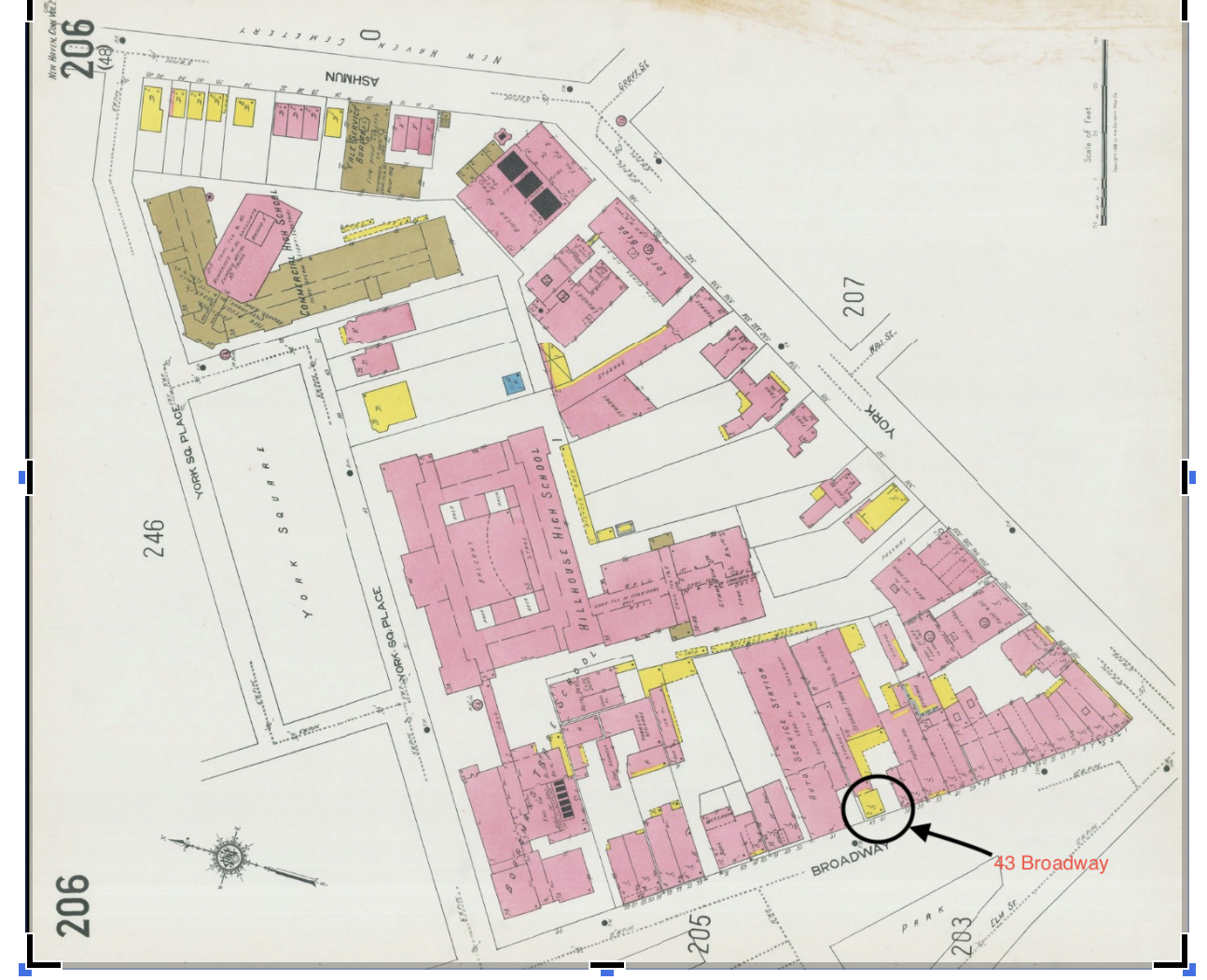
By 1900, Broadway experienced a shift in tenancy and began to emerge as a predominantly commercial street. During this era, it developed into a commercial strip. Throughout the century, 43 Broadway cycled through many tenants, including a brief period in 1923 when the space was used as a storage unit. It continued to function as a commercial space, alongside neighbors such as Post Liquor Shop, “The Nearest Shop to College,” located at 5 1⁄2 Broadway next to College Toasty.
Some notable establishments at 43 Broadway included Max S. Simons, designer and tailor of fine garments in 1938, Martin’s Jarman Shoes for Men in 1946, and Quality Wine Shop which closed presumably in the 1980s .
After a fire destroyed a large portion of 1 Broadway in 1943, the area was rebuilt and redeveloped, likely influencing the surrounding blocks, including 43 Broadway. The most significant redevelopment of Broadway occurred in the 1990s, when Yale, in an effort to revitalize the street, partnered with the city of New Haven, the state of Connecticut, and the federal government. They spent over $10 million in a project lasting more than five years to redevelop the street.
In 1991, the retail corporation Urban Outfitters moved into 43 Broadway, marking the first step in transforming Broadway into the landscape we see today. Urban Outfitters officially opened in 2001 and has remained there for 24 years and counting.
The role Urban Outfitters played when moving into 43 Broadway was the first of many years of slow and systemic change, transforming Broadway from a hub for New Haven locals into a shopping street primarily for Yale students. While it is true that Yale has undoubtedly altered the landscape of Broadway, it has also invested millions of dollars into the city, reviving an economy that had declined due to the fall of local manufacturing.
Before the 2000s, Broadway was owned by locals, with locally owned businesses and local patronage. However, the alumni and Yale community viewed the area as undesirable due to its image. This conclusion is particularly intriguing because it likely has racial undertones, as it is believed that the development of Broadway has created a divide between the predominantly Black neighborhood of Dixwell Avenue and Yale’s campus. This mentality is widely echoed among many New Haven residents today, who believe Yale is gentrifying their neighborhoods by buying up properties, raising rents to astronomical prices, and pushing out locally owned businesses while also not paying property taxes. On the other hand, Yale has boosted New Haven’s economy, created numerous job opportunities, and provided services for students.
The redevelopment of Broadway into an upscale retail street has had lasting effects on the street and the population that frequented the area. Although it might now be less intimate, the prevailing argument is that it has become highly commercial. The first store to mark this change was Urban Outfitters, a corporate retail store that started the trend of transformation and most likely contributed to/attracted other large corporations to rent that stretch of Broadway.
Urban Outfitters is located in a prime retail area because the location receives a lot of foot traffic. This is largely due to the presence of nearby commercial buildings that attract a diverse crowd. Yale students frequently pass by on their way to classes, while tourists visit Bluemercury, a beauty supply store next to Urban Outfitters, as well as nearby coffee shops, cookie shops, and the Yale Bookstore. The Yale Bookstore is also a major attraction for tourists, so more people are likely to stop by when passing through the area.
The building directly next to Urban Outfitters is a two-story brick structure with an Italianate style. The lower floor is occupied by two stores: Paper Source and Cookie 39. This building is similar in height and proportions to Urban Outfitters. On the other hand, to the left of Urban Outfitters is Bluemercury, a shorter building that reflects a minimalistic aesthetic with a bright white, industrial-style facade.
With a mix of grocery stores, casual dining options, dessert shops, and a live music venue/nightclub, the area is teeming with people eager to shop. The location is also highly visible from the street without being too close; instead, it is set slightly back from the sidewalk, allowing room for the flow of pedestrians.The combination of well-known brands, unique specialty stores, and casual dining options makes this location ideal for retail.
Standing between two buildings with vastly differing architectural styles from different eras is 43 Broadway, a two-story, flat-roofed building with 11,800 square feet of space. The building is contemporary in style, with the primary materials being glass, steel, and composite metal panels. It follows a contemporary commercial architectural design, contrasting with its larger neighbor on the right, which features a 19th-century brick-pattern facade. The design is characterized by a minimalist use of industrial materials and a transparent structure.
The front elevation of the building is dominated by rectangular glass windows framed by metal mullions and spandrel panels, emphasizing the uniform and repetitive arrangement of the glass curtain wall. The building has a uniform appearance, with its dark grey exterior, a row of large windows, and large white block letters spelling out “URBAN OUTFITTERS.” The signage avoids additional ornamentation and hangs about two-thirds of the way down the building, seemingly hovering over the space that separates the top and lower rows of windows. The partition itself appears grated with a two-row grid system that seems to be made of concrete.
The door to 43 Broadway is a French door, nearly indistinguishable from the windows in size and appearance except for the two metal handles and the kick plate at the bottom. The entire building is centered around this door, with two windows flanking each side. The horizontal line that divides the upper windows aligns precisely with the center of the French door.
Inside the building is a large, open space with various displays, including a spiraling staircase that leads to the second floor with a smaller landing in between. The walls and display shelves are made of light-colored wood, with track lighting that reflects off the wood accents, adding dimension, warmth, and depth to the minimalist furnishings. The space also features exposed structural elements, open ceilings revealing ductwork and steel trusses, and polished concrete flooring.
The landing between the two floors is a small, semi-circular space with light-colored concrete extending from the otherwise wooden wall. It is enclosed by the spiraling stairs leading to the second floor. On this floor, clothing is also displayed, though mostly on racks rather than shelves.
The second floor continues the same aesthetic as the first, except it feels even more spacious without the staircase blocking the view. This brings the exposed steel pipes into sharper focus as they extend in multiple directions. The visible partitions for the fitting rooms stop short of the ceiling, creating the illusion of greater height and openness.
American Beat Films. “On Broadway: A New Haven Streetscape.” American Beat Films,
Buildings, Grounds and Landmarks in New Haven Photographs (RU 685). Manuscripts and Archives, Yale University Library,
https://yaledailynews.com/blog/2006/11/30/broadways-commercial-history-examined-in-a-film/.
Broadway. 1960. Yale University Library Digital Collections,
https://collections.library.yale.edu/catalog/10011420.
Broadway. 0 AD. Yale University Library Digital Collections,
https://collections.library.yale.edu/catalog/10011417.
Google Maps. “Broadway, New Haven, CT.” Google Maps Street View,
Insurance Maps of New Haven, Connecticut. Vol. 2, Sanborn Map Company, 1924. Yale University Library Digital Collections,
https://collections.library.yale.edu/catalog/11190119.
Infonew Haven. “History of New Haven.” Infonewhaven,
https://www.infonewhaven.com/history/.
New Haven GIS. “Parcel Information.” City of New Haven GIS,
https://gis.vgsi.com/newhavenct/Parcel.aspx?Pid=14955.
Sanborn Map Company, issuing body. Insurance Maps of New Haven, Connecticut. Volume 2. 1924,
https://collections.library.yale.edu/catalog/11190119.
Urban Outfitters. 0 AD. Yale University Library Digital Collections,
https://collections.library.yale.edu/catalog/16196812.
Urban Outfitters. “History.” URBN,
https://www.urbn.com/who-we-are/history.
Uneven Earth. “Broadway, New Haven.” Uneven Earth, May 2015,
https://unevenearth.org/2015/05/broadway-new-haven/.
Yale Archives. “Archival Objects Related to Broadway, New Haven.” Yale University Library,
https://archives.yale.edu/repositories/12/archival_objects/1007797,
https://archives.yale.edu/repositories/12/archival_objects/1007799.
Yale Daily News. “Broadway’s Commercial History Examined in a Film.” Yale Daily News, 30 Nov. 2006,
https://yaledailynews.com/blog/2006/11/30/broadways-commercial-history-examined-in-a-film/.
Yale Daily News. “With Opening Urban Outfitters to End Vintage Void on Saturday.” Yale Daily News, 30 Mar. 2001,
Yale Daily News. “Selling Broadway.” Yale Daily News, 1 Feb. 2008,
https://yaledailynews.com/blog/2008/02/01/selling-broadway/.
Yale Daily News Historical Archive. 7 Mar. 1940,
https://ydnhistorical.library.yale.edu/?a=d&d=YDN19400307-01.2.15.1.
Yale Daily News Historical Archive. 23 Sept. 1946,
https://ydnhistorical.library.yale.edu/?a=d&d=YDN19460923-01.2.32.1.
Yale Daily News Historical Archive. 10 Oct. 1938,
https://ydnhistorical.library.yale.edu/?a=d&d=YDN19381010-01.2.24.1.
Yale Daily News Historical Archive. 1 June 2006,
https://ydnhistorical.library.yale.edu/?a=d&d=YDN20060601-01.2.63.31.
Yale New Haven Building Archive. “Building ID 46.” NHBA Yale,
https://nhba.yale.edu/building?id=46&utm_source=chatgpt.com.
Saved edits to this building (newest first). Each row is logged when an editor saves changes.
| When | Editor |
|---|---|
| Mar 10, 2026, 4:00 PM ET | daniel.morales@yale.edu |
Researcher
Bethelhem Kebede
Date Researched
October 8, 2025
Entry Created
February 17, 2026 at 4:51 PM EST
Last Updated
March 10, 2026 at 4:00 PM EST by daniel.morales@yale.edu
Style
ContemporaryCurrent Use
CommercialEra
1980-TodayNeighborhood
BroadwayYear Built
1999-2001
Architect
HBRA Architects, Chicago, IL
Current Tenant
Urban Outfitters
Roof Types
FlatThreats
None knownDimensions
11,800-square-feet
Owner
Urban Outfitters
Ownernishp Type
2;4
Client
Yale University
Historic Uses
CommercialComments
You are not logged in! Please log in to comment.