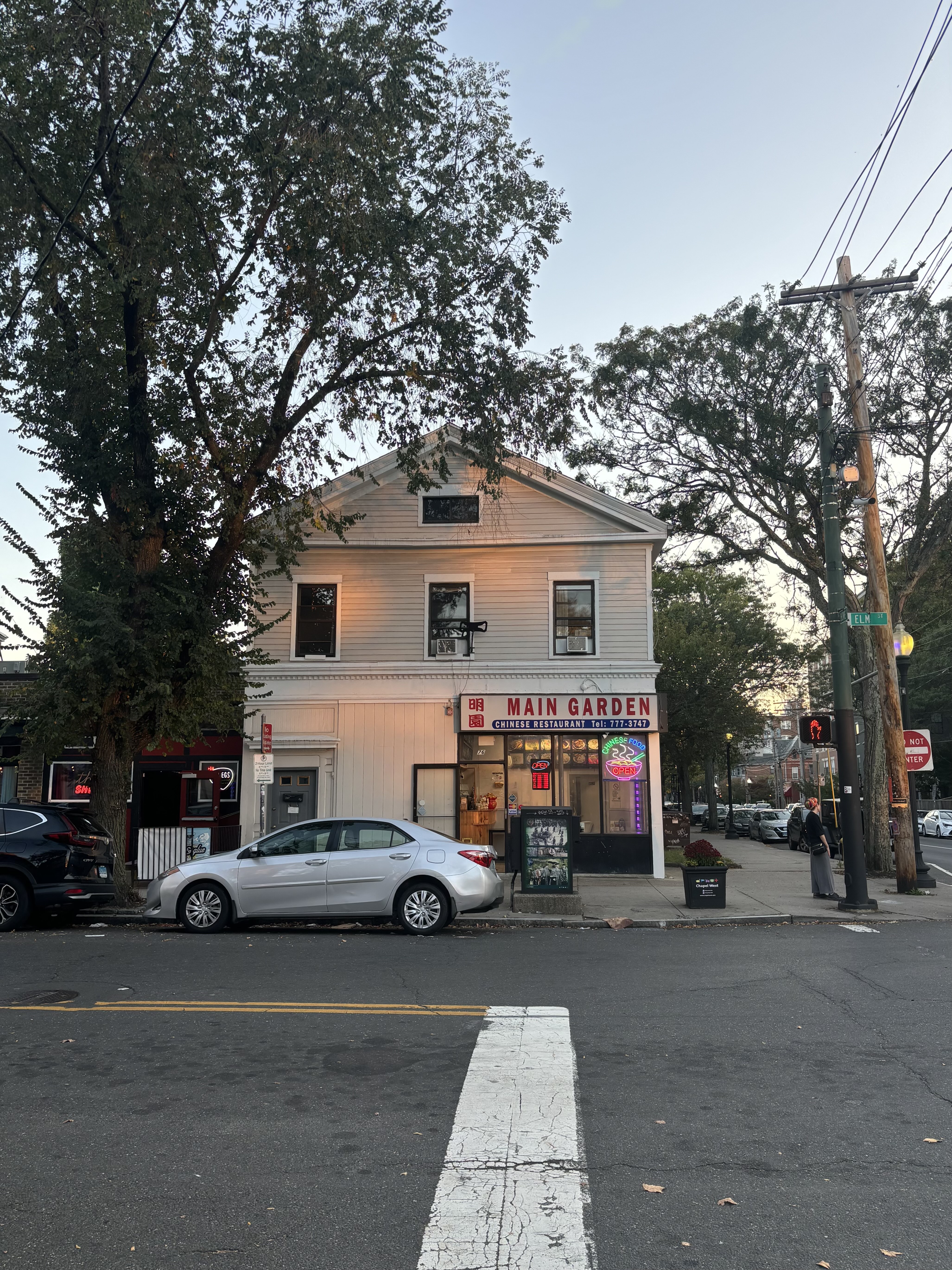
376 Elm St/Main Garden Chinese Restaurant
376 Elm Street, New Haven, CT 06511
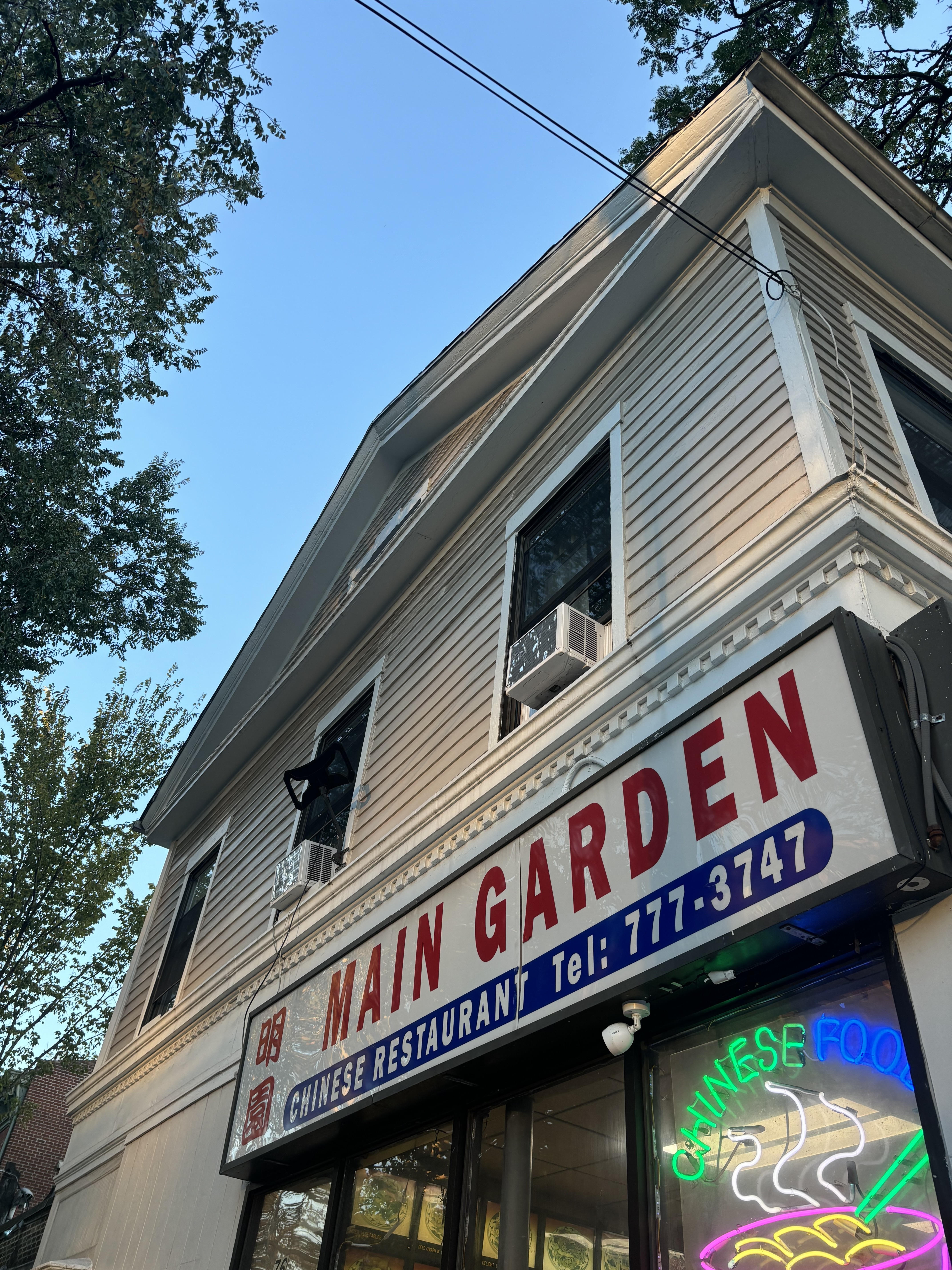
The technical term for 376 Elm’s architectural style is Greek-Revival; however, the black metal framing and glass windows of the Main Garden Chinese Restaurant disrupt the smooth symmetry expected of Greek-Revival buildings. This slight ripple in the building’s simple exterior harmony aptly translates to its social function, which has fluctuated consistently throughout its long history. The building has undergone far more tenant changes than physical alterations, though it has its fair share of those as well. Its commercial sites have housed one-year business stints and storied New Haven restaurant establishments. 376 Elm’s ever-changing story reflects perfectly New Haven’s own narrative of growth; in spite of its contradictions, the building’s dominant influences have been the people that live in and take up its space ever since its inception.
Tenants: Etta C. Burroughs (1913), Thomas Powell (1913- c.1917), George K. Stevenson (1914- c.1917), Josephine Quinlan (1917-c.1920), Frank Celentano (c. 1920- c. 1940), Theodore J Mucha (c. 1961- c. 1972), Edward J. Pierce (c. 1974), Elliot Peters (1980), Cody Sen Chan (2005), Chan Tuen Pang (2005). Other years’ tenants’ names were not listed, or residences were vacant.
Documented Commercial Uses: Grocery Store (three times: Celentano and Antonopoulos A Grocers, Howe Grocery), Spa, Deli, Restaurant (Fat Taco Mexican, Bunuel’s Restaurant, Main Garden)
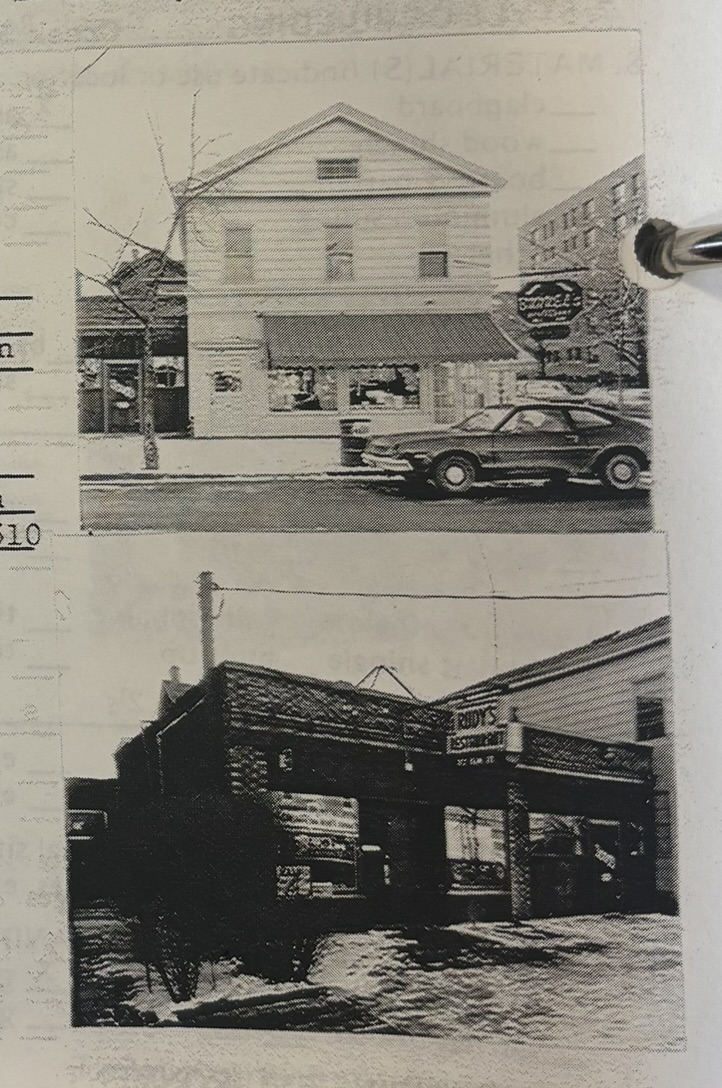
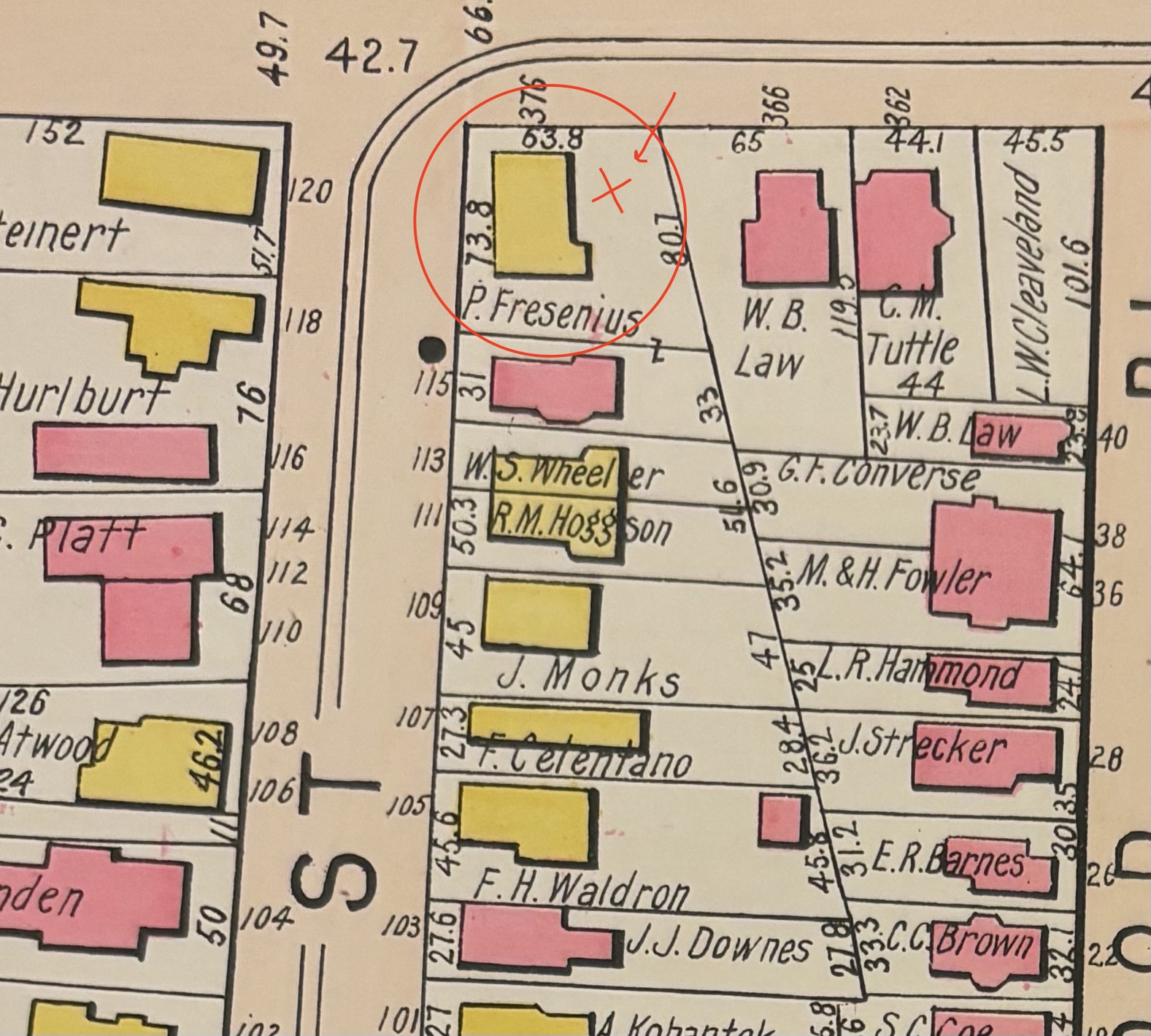
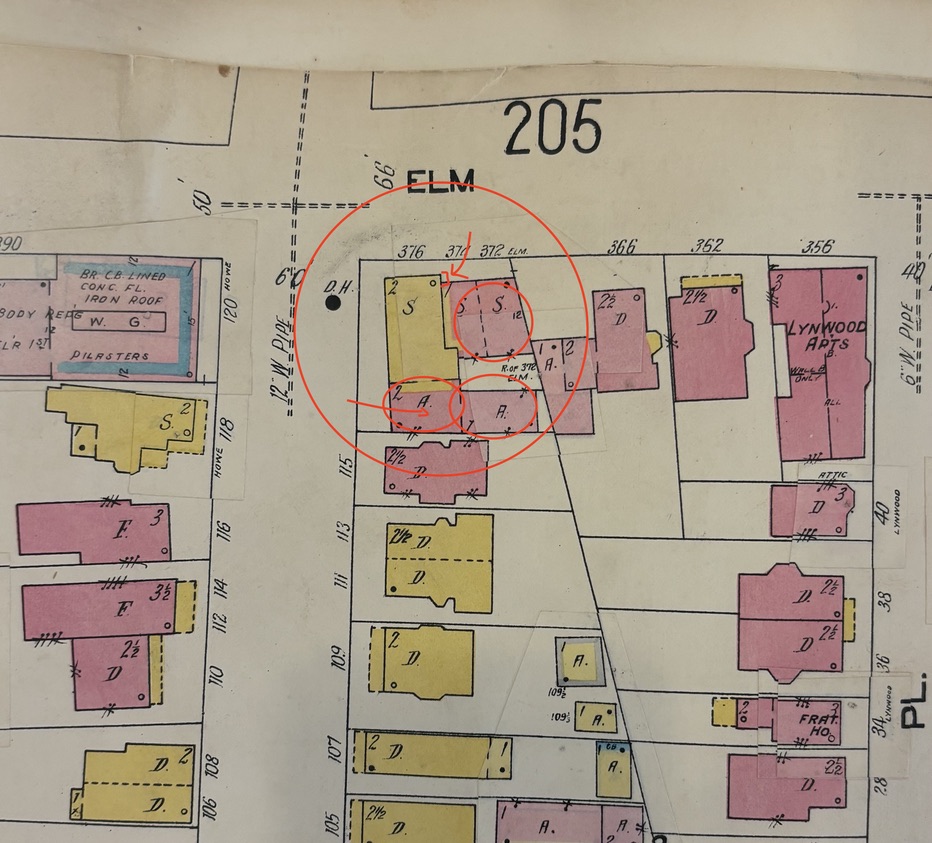
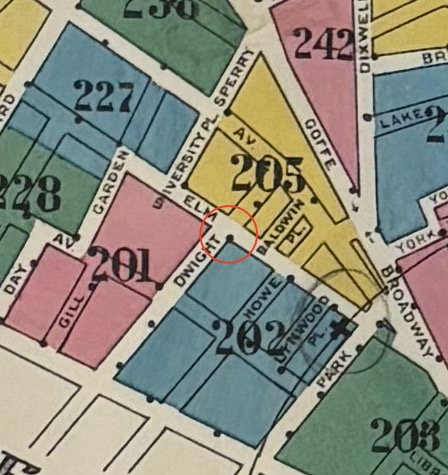
The Sanborn Fire Insurance maps I consulted place 376 Elm on the border of two districts or map “plates”; its site fringes the main and primarily commercial Broadway neighborhood and the adjacent residential area that bleeds into Chapel West. The Maps provide the most crucial information about site history and ownership; from the 1888 map which indicates P. Frenesius as an owner (who is different from the original E. Bradley indicated on the New Haven Resources Inventory page) and a sole wood-frame building to the 1923 map with no owner listed despite four new brick structures present on the property. The brick addition east of the 376 Elm wood frame was finished for the last time around the 1970s, at which point it became the quintessential home of Rudy’s Bar and Grille (which had still occupied the site beforehand, just not in its familiar one-story industrial façade).
376 Elm’s social history reveals its quintessential embodiment of New Haven’s urban growth patterns. The record from the New Haven Resources Inventory, filed in 1979 under the Connecticut Historical Commission, shows that the building was constructed circa 1845 as a single-family home with one owner serving as their own tenant. I saw Sanborn maps starting from the 1888 editions, and only in the 1923 iteration did brick structures appear to have been constructed adjacent to the original wood-frame building. Ten years earlier began the documentation of New Haven residents in city directories, and even in the 1913 edition, multiple independent tenants are reported to have lived in 376 Elm. This dynamic timeline suggests that the building expanded in versatility as time passed, likely responding to population growth, especially as industrialization progressed after the Civil War. The city’s rapid growth and reorganization continue to reflect in the sheer number of different tenants I observed in the city directories. Many tenants only stayed for a year, and multiple years either list no tenants or read “vacant”; the building’s residential use was volatile during much of the 20th century. Its commercial function, however, thrived before and since its additions were constructed in the 1920s/30s. Two long-standing grocery stores occupied the property in the early 20th century: Celentano Grocers and then, starting in what appears to be 1938, Antonopoulos A Grocer (although Frank Celentano was still a tenant in this year; residential and commercial history swirled and overlapped). For the stint of a single year, the Howe Spa and Delicatessen took residence in the 376 Elm plot; the story of that surprisingly multi-faceted business and its rapid failure are only imaginable to me now. After the Spa and Deli, Antonopoulos A Grocer returned until it became Howe Grocery in what I found to be 1961. With more difficulty in identifying specific start and end years, I found records of restaurants called Bunuel’s and Fat-Taco Mexican occupying the space in the 70s and 80s. Finally, in 1992, Main Garden Chinese Restaurant took its place in the restaurant space, where it stands today. As 376 Elm expanded, its tenants and number of them fluctuated, and its commercial spaces bounced between long-standing establishments and fleeting occupants, it responded to the equally dynamic changes that came in the surrounding urban center of an expanding city.
The building’s bright wooden exterior contrasts most of the other structures on its block, which are primarily 19th/20th century dark red brick apartment buildings combining elements of neo-colonial and industrial style. In function, though, 376 Elm blends with its urban setting as a simultaneous residential and commercial property. The block and intersection contain two restaurants and a liquor store in addition to the two on the 372-376 property, and the rest of the buildings are multi-family residences or apartments. The casual, low-budget offerings of these businesses reflect the buildings’ proximities to Yale’s campus and housing popularly used for students living off-campus: college students pay for cheap eats. This area is as calm as Elm Street gets; the residential setting is a relatively peaceful one. However, without public green space on the street or space for convening between the sidewalk and the residential entryways, save for small front stoops on the stairways of a few other buildings on the block, the area is safe but not necessarily conducive to communal gathering or prolonged interaction.
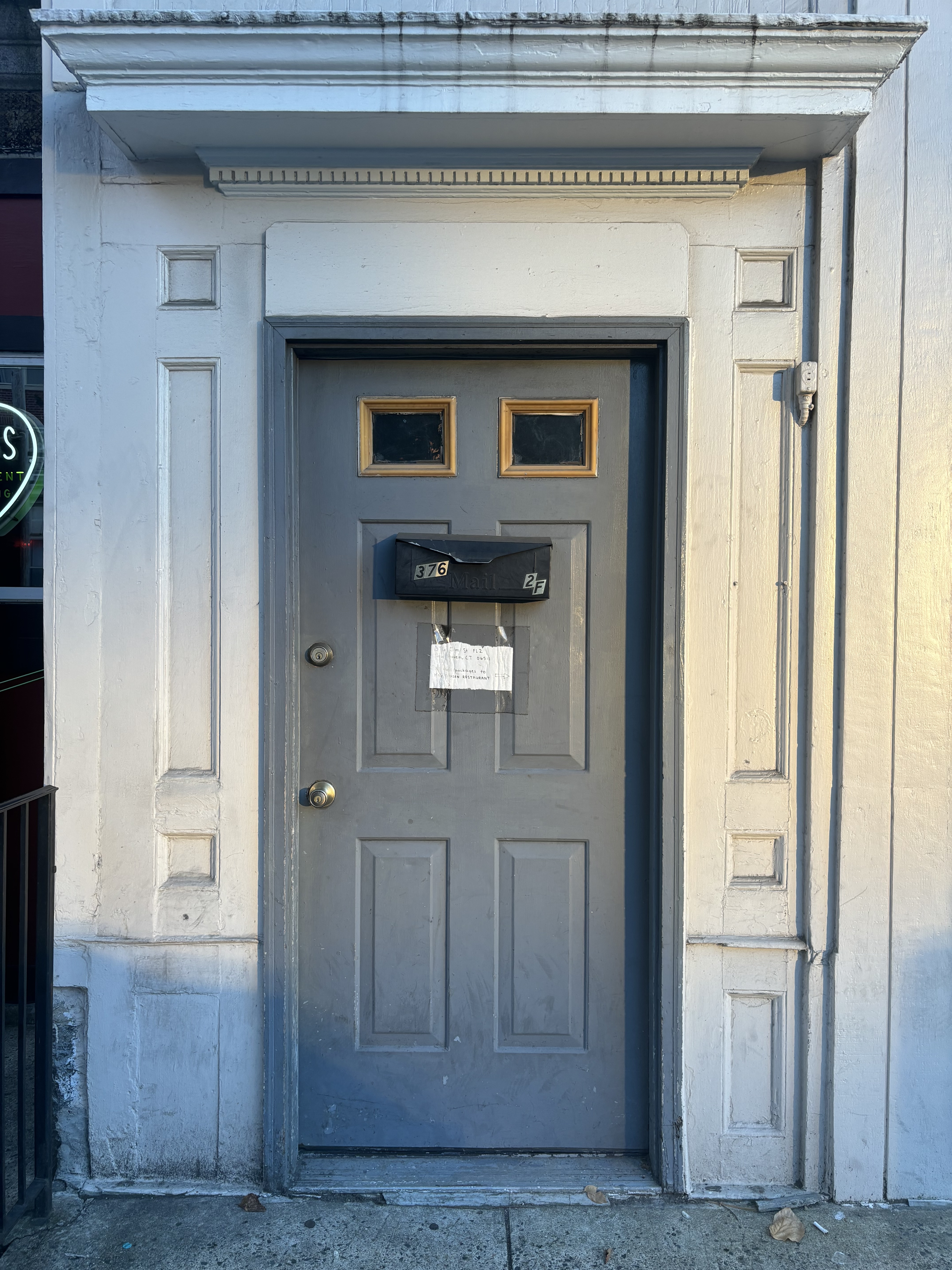
The light cream coloring of the building’s paneled siding complements its simple Greek Revival façade, but the restaurant in its bottom right corner, its bright red and blue sign, and its full-length glass windows disrupt the building’s typical style expression. The paneling covers the second story of the front façade, which also has three rectangular windows with unornamented white pediments, and the attic, which has a single horizontally oriented window. Beside the restaurant front on the bottom floor is a smooth wall of vertical planks and the blue-gray door to one of the residential units; that door has a small frame ornamented with Greek-temple inspired molding. The molding separates the first and second floor on the exterior and frames the building’s triangular pointed roof. Only the metal framing of the restaurant, its glass windows, and its plastic sign are not made of wood. 376 Elm’s wooden paneling wraps around its Elm-street-facing front to its much longer side, facing Howe Street, which also contains the other two residential unit entry doors. The furthest down Howe of these two appears to connect to a unit which was added later than the original structure’s construction, for its roof is slightly lower and it is the only door with a staircase and handrails. The building sits directly on the sidewalk with no offset space or landscaping, save for a small patch of grass on the side face between the restaurant and residential entry. Despite yellowing menus and chipping painted walls in the restaurant’s interior, the exterior is well-kempt.
To delve briefly into Three Sheets Bar, the business that occupies the adjacent and once-connected building at 372 Elm: the bar has an industrial-looking brown brick and red-and-black wood paneled façade. In the bar’s front windows are bright blue curtains which contrast the other featured colors. This building is offset back from 376 Elm by about ten feet, which creates space for an outdoor seating area, which the business frames with a thin-barred metal fence hung with advertisements for local events.
- New Haven Historic Resources Inventory, Phase One: Central New Haven, New Haven Preservation Trust Connecticut Historical Commission. Reprinted 2000
- Insurance Maps of New Haven, Connecticut, Sanborn Map and Publishing Co., 1888
- Insurance Maps of New Haven, Connecticut, Sanborn Map and Publishing Co., 1923
- New Haven Directory, Price & Lee Co, 1913 - 2005 Editions
- “After 67 Years, Rudy’s Moves Up”, New Haven Independent, June 22, 2010, Melissa Bailey https://www.newhavenindependent.org/2010/06/22/after_76_years_rudys_moves/
- New Haven, CT Tax Assessor’s Office Property Lookup, https://gis.vgsi.com/newhavenct/Parcel.aspx?Pid=16813
- Incomplete Yale Building Archive page for 372 Elm by Nicky Chang, 2011 https://nhba.yale.edu/building?id=12
Saved edits to this building (newest first). Each row is logged when an editor saves changes.
| When | Editor |
|---|---|
| Jun 15, 2026, 8:11 PM ET | carter.flemming@yale.edu |
Researcher
Carter Flemming
Date Researched
October 3rd, 2025
Entry Created
February 15, 2026 at 9:19 PM EST
Last Updated
June 15, 2026 at 8:10 PM EST by carter.flemming@yale.edu
Style
Greek RevivalCurrent Use
Detached Multiple Unit DwellingRestaurantEra
1638-1860Neighborhood
BroadwayYear Built
1845
Architect
Unknown
Roof Types
GableThreats
None knownDimensions
70' x 70'
Owner
Hang Seng Inc.
Ownernishp Type
2
Client
First recorded owner, documented in 1851, was an E. Bradley. No documentation I found states whether he was the original owner or patron of its construction.
Historic Uses
Detached Multiple Unit DwellingRestaurantGrocerySpaDeli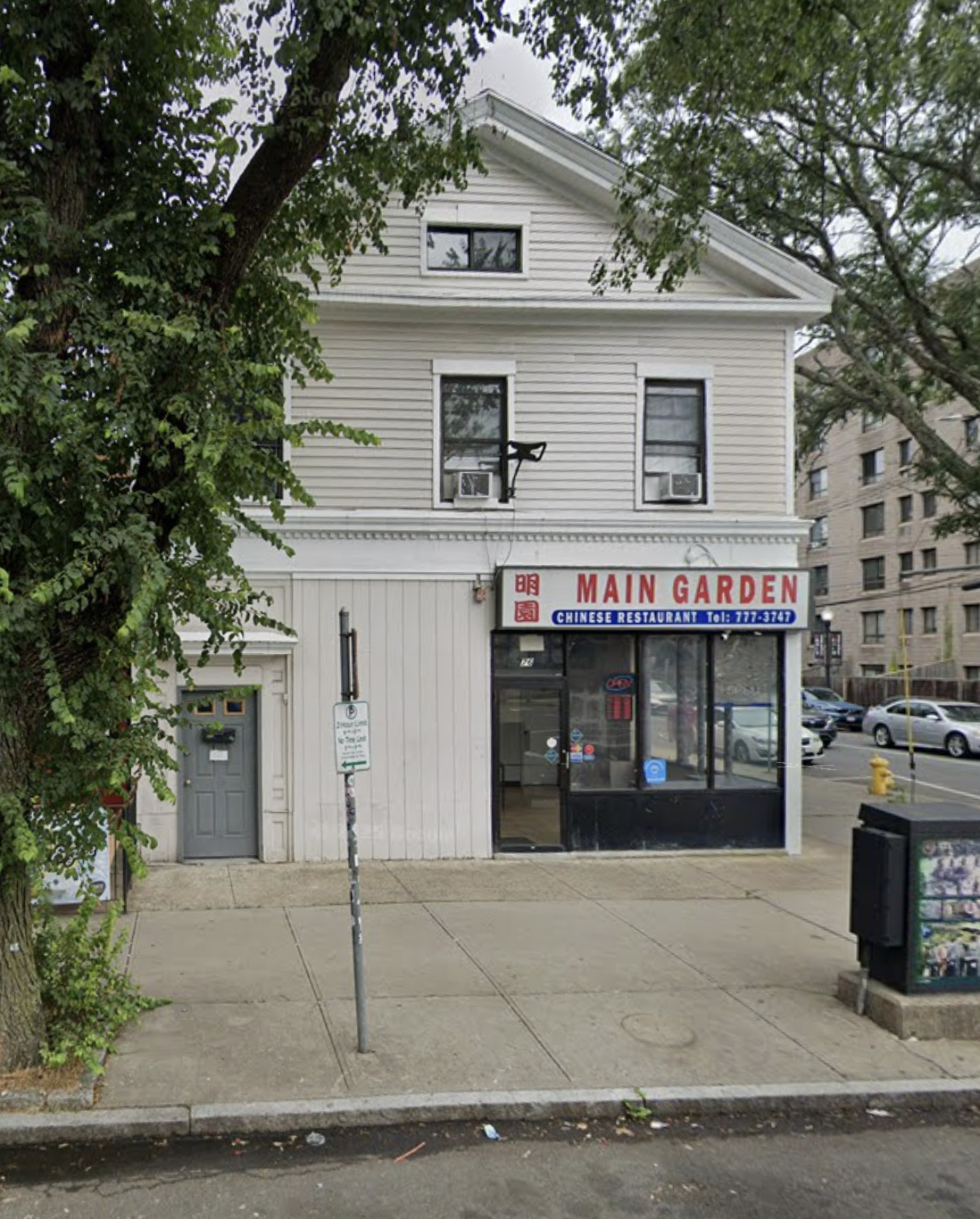
Comments
You are not logged in! Please log in to comment.