Neighborhood Music School
100 Audubon Street, New Haven, CT 06510
The Neighborhood Music School’s location is central to its purpose, with it being the first building and anchor of New Haven’s Audubon street arts district. Organizations like the Creative Arts Workshop, The Community Foundation for Greater New Haven, the New Haven Ballet, and the Educational Center for the Arts are all within a few steps of this building on a street distinctly characterized by a large amount of pedestrian traffic.
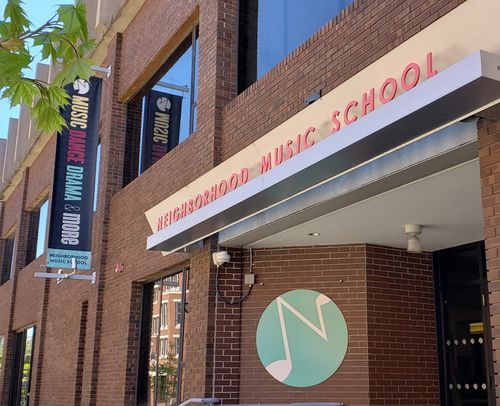
When the arts district was first being proposed, there was an idea to make it a “South Street Seaport-like atmosphere conducive to pedestrians”. However, due to the parking garages and lots that were built, it was impossible to fully pedestrianize the street– thus, Leeney Plaza was built, introducing a curve in the road that simultaneously slowed cars and created a central space to connect the arts organizations together. Although the street itself is one-way and relatively narrow, the sidewalks are wide enough to accommodate outdoor seating from a nearby cafe and for people to stop and chat, creating an ever present friendly atmosphere as the visitor approaches NMS. As one of the most prominent structures on the street, it is impossible to bypass without noticing the concrete elements on the third floor, large steel-trimmed windows, and people flowing in and out of the main entrance located in the center of the facade.
The Neighborhood Music School is the only tenant of the building that currently stands at 100 Audubon Street, The site was previously occupied by a group of small industrial factories (see "Social History" section).
100 Audubon street as it stands today was built for the purpose of housing the expanding Neighborhood music school in 1968. The School was first started as part of a community program for St. Paul’s Episcopal Church in Wooster Square in 1911, but expanded into its own incorporation in 1945. At the time when the building of their new facilities began in 1968, the institution was housed at 612 Chapel Street, a large mansion in the late Victorian and early 20th century style. The site of the future building was decided to be on Audubon Street, a street that had once been an important part of the manufacturing industry but had become much less prominent and more dilapidated as time went on and consumers moved to different parts of the city for goods.
The previous occupants of this site on Audubon street were industrial buildings. On fire insurance maps from 1901, the site that NMS is located on today is occupied by a birdcage factory which neighbored the McLagon Foundry machine shop and the New Haven Manufacturing Company, at different points in time. Leeney Plaza did not yet exist– instead, Audubon street runs straight with no curvature to indicate the plaza that exists there today. After one of the factories was demolished in 1944, the site saw little to no activity and many of the buildings lay vacant, a symbol of New Haven in the post industrial age. The block became even more quiet after the synagogue farther down the street, which was built in 1897 , moved its congregation to Hamden. When NMS was built in 1968, it interrupted an almost 20 year hiatus of development in the area, and kickstarted a new era where the area would be redeveloped to serve the community through the arts instead of industry.
The Neigh School was first started as part of a community program for St. Paul’s Episcopal Church in Wooster Square in 1911, but expanded into its own incorporation in 1945. At the time when the building of their new facilities began in 1968, the institution was housed at 612 Chapel Street, a large mansion in the late Victorian and early 20th century style. The site of the future building was decided to be on Audubon Street, a street that had once been an important part of the manufacturing industry but fell into disuse as consumers moved to different parts of the city for goods.
The Neighborhood Music’s school location in the heart of New Haven’s arts district has greatly influenced its relationships with its surroundings. As aforementioned, the most notable characteristic of the arts district as it stands today is the heavily pedestrianized environment and lack of cars. Because the sidewalks are wider and the streets consequently narrower, there is very little to no street parking and the atmosphere is completely different to that of the neighboring Whitney Avenue and Orange Street.
The segment of Audubon street between Whitney and Orange streets is often blocked off to make way for public pedestrian-only events. The concentration of arts organizations has led to a microcosm of the performing arts that is centered around the built environment of Leeney Plaza, which hosts live music performances, open air vintage markets, the Educational Center for the Arts’ yearly graduation, and public events hosted by the city. The sense of community that exists today on Audubon Street began with the Neighborhood Music School’s establishment in that location, and continues because of the high concentration of arts organizations that line it. The Neighborhood Music School acts as anchor for the other organizations on the streets, and continues to be a representation of the impact of the arts on a community.
The building of NMS itself is largely in the modern institutional style, with some elements of brutalist-adjacent influence towards the top of the building. The building project began in 1968, with the new facility opening by the fall of 1969. Similar to other buildings constructed during that time period, it emphasizes practicality and useability, with straightforward materials like brick and glass being the main components. The windows of the third level are slanted upwards and separated with concrete triangles, the heavy and block-like nature of which harken towards brutalist influence. A streamlined brick facade that has minimal other decorative elements is interrupted by large steel framed windows and evenly dispersed brick pilasters that jut out of the wall, providing some visual rhythm to what would be an otherwise static face. The building was clearly designed with functionality and budget in mind, as it is not overly decorative despite being an institute of artistic learning. The side of the building that faces a small parking lot is a plain brick face with no decorative elements, suggesting that the building was also designed with the possibility of urban growth directly adjacent to it in mind.
The text A Brief History of the Neighborhood Music School describes the trajectory of NMS since its founding in 1911 as a program run out of the St Paul’s Episcopal Church, and how the school moved between various different locations in the New Haven area before a larger building was finally commissioned to accommodate the increasing number of students.
There is a staircase that leads up to the porch in front of the main entrance, which is a playful light gray that curves outwards towards the street and invites visitors to come inside. The door is set back from the main facade of the building to create a sort of funnel, drawing the visitors inside. Visitors are greeted inside by a reception desk and atrium, which continue the playful theme of the curved staircase with a similarly curved desk, and a round column in the middle. The walls are made of vertically aligned tiles of brick, the uniformity of which draws attention to other things happening in the space like the chatter of musicians on the way to rehearsal or the dancers stretching before their class.
“Audubon Arts District: Urban Redevelopment That Works.” New Haven Register, 17 July 2013, www.nhregister.com/news/article/Audubon-Arts-District-Urban-redevelopment-that-11589719.php.
“Guv Hears the Music.” New Haven Independent, 11 Mar. 2014, www.newhavenindependent.org/2014/03/11/guv_hears_the _music/.
Neighborhood Music School: Our History. Neighborhood Music School, www.nmsnewhaven.org/history. Accessed 1 Oct. 2025.
New Haven Preservation Trust. New Haven Modern. New Haven Preservation Trust, nhpt.org/new-haven-modern. Accessed 3 Oct. 2025.
New Haven Redevelopment Agency. Redevelopment and Renewal Plan for Audubon Street Project Area. New Haven, 1970s.
Yale University Library. Redevelopment and Renewal Plan for Audubon Street Project Area. Yale University Library Digital Collections, collections.library.yale.edu/catalog/11199137.
A Brief History of the Neighborhood Music School by Leon B. Platinga, a local musicologist who wrote a pamphlet on the history of NMS for the institution’s centennial in 2011.
They Who Speak In Music: The History of the Neighborhood Music School by Clarence A. Grimes. Published by the Neighborhood Music School in 1957.
Saved edits to this building (newest first). Each row is logged when an editor saves changes.
No recorded edits yet.
Researcher
Amelia Shaw
Entry Created
December 3, 2025 at 4:41 PM EST
Last Updated
January 3, 2026 at 7:42 PM EST by yumpEditor
Style
BrutalistCurrent Use
Non-Profit (ex. Planned Parenthood, Salvation Army)SchoolEra
1950-1980Neighborhood
Whitney-AudubonYear Built
1968
Architect
Charles Brewer
Roof Types
FlatThreats
None knownDimensions
80” x 33” , 98” x 60”, 35” height
Owner
Neighborhood Music School, Inc.
Ownernishp Type
2
Client
Tomlinson & Hawley, Trumbull CT
Historic Uses
SchoolNon-Profit (ex. Planned Parenthood, Salvation Army)Comments
You are not logged in! Please log in to comment.