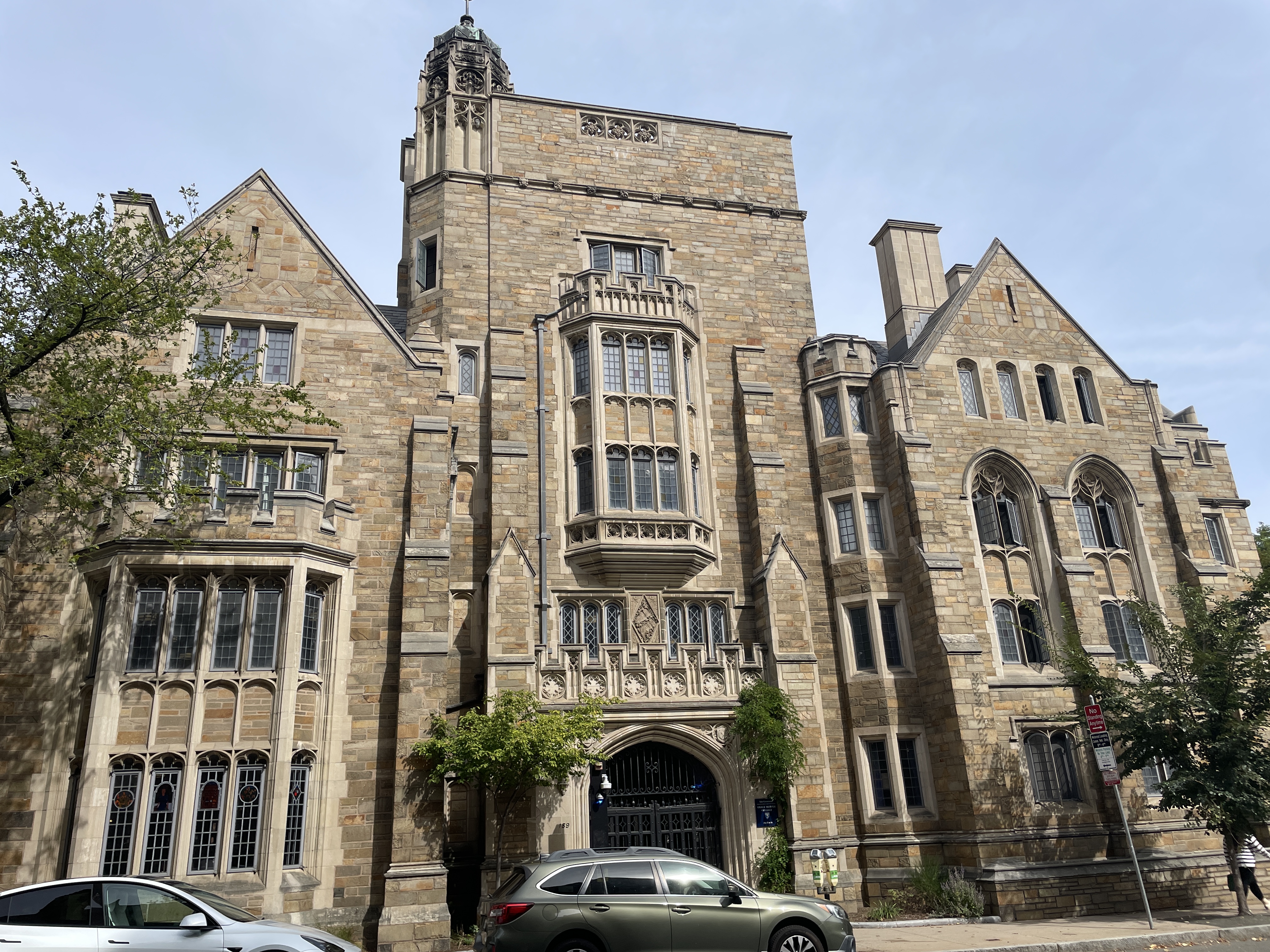
Grace Hopper College
189 Elm Street, New Haven, CT 06511
Grace Hopper College on Elm Street is defined by a compact, Collegiate Gothic block of brick and stone surrounding a central, grassy courtyard that frames semi-private student life. Unlike the rest of the original residential colleges at Yale designed by architect James Gamble Rogers, Hopper (Calhoun at the time) was designed by John Russell Pope2. The perimeter of the college is characterized by arched doorways, ornately carved stonework, and a courtyard that is surrounded by scattered shrubbery and small trees. Built for Yale in the early 1930s as one of the university’s original residential colleges, the building now functions as a hub for undergraduate life, boasting suite-style housing with bedrooms joined by a central living area. The residential areas are accessible by vertical entryways that lead into suite common rooms. As is the case with other residential colleges at Yale, Hopper College features a dining hall, library, and other commons spaces concealed below-grade (fitness facilities, common areas, etc.). Recent work by Newman Architects has modernized Hopper’s interior while preserving the historic Gothic exterior and ornamental details scattered throughout the college.3 The college’s name has been a point of contention in recent years, as it was built as Calhoun College in 1932 and recently renamed Grace Hopper College in 2017. This building is not only notable architecturally, but also in the context of sociology with the college’s recent renaming speaking to how debates over commemoration have played out.
Yale University (1932-Present)
The land that Hopper College sits on was originally inhabited by indigenous peoples nearly 8000 years ago, primarily the Quinnipiac tribe. After the English arrived in New Haven, in 1641 John Brockton established a farm on the exact land Hopper College sits on today. After the Revolutionary War (roughly post-1783), an inn was constructed which the Phi Beta Kappa Society met at. From 1863 to 1874, the land became the site for Yale’s Divinity School. The previous Divinity School was home to East Divinity Hall (1869), Marquand Chapel (1871), West Divinity Hall (1871), and Trowbridge Library (1881). With the plans to create the residential college system, the original Divinity School buildings were demolished and the current Divinity School moved to its current campus on Prospect Street. A fun fact is that Hopper College’s Buttery is named “The Trolley Stop” because Hopper sits at the corner of Elm St. and College St., where trolleys used to go “screeching around the corner”.
Since the construction and opening of the residential college in 1932, Yale University has owned the property. The building was originally named Calhoun College after John C. Calhoun, a notable Yale alum who was celebrated in the early 20th century but later became a contentious figure because of his advocacy for slavery. Hopper College housed Yale undergraduates and the college’s associated faculty from its opening until now.
As a residential college, the building’s primary tenant group has been successive cohorts of Yale undergraduates (plus faculty masters and graduate affiliates). The college’s social role has been both everyday and symbolic: it has functioned as living quarters, dining hall, a center for small-group academic life (seminars, tutors’ rooms, fellows’ events), and a locus for residential traditions and ceremonies that help form cohort identity.
Over the late 20th and early 21st centuries the college remained a hub for everyday student life (housing, dining, social programming) despite rapid changes: Yale’s student body grew more diverse, colleges became co-ed in the late 1960s, and ongoing maintenance and restoration projects periodically modernized the plant while preserving the Gothic. The college’s social meaning also shifted, the college carried the name of John C. Calhoun which became the subject of campus activism and debate. By the 2010s students, staff, and New Haven community members increasingly challenged the wisdom of honoring Calhoun on a student residence. Protests, petitions, and public conversations culminated in Yale’s 2017 decision to rename the building Grace Hopper College — a symbolic turning point reflecting changing norms about whom universities choose to memorialize.
The name controversy was not merely symbolic: it intersected with specific episodes that dramatized town–gown relations and questions of accountability. In 2016 a Yale cafeteria worker, Corey Menafee, smashed a stained-glass panel in the college that depicted enslaved people — an act that catalyzed public debate, legal and employment consequences, and a broader reckoning that fed into the renaming movement. Menafee’s case, its aftermath, and the public conversation around it drew both local and national attention to the college as an arena where labor, race, and memory collided.
More recently, Yale and the New Haven arts community have used the college’s interiors to reframe that contested history through commissioned artworks: in 2022 Yale installed twelve new stained-glass windows by African American artists (Barbara Earl Thomas and Faith Ringgold) intended to acknowledge the painful past and offer new narratives inside the dining hall and library spaces. Local community events and public conversations accompanying the window installations indicate an intentional effort to both mend community ties and use the college’s symbolic spaces for public education and reconciliation. These artistic commissions underscore the building’s double role as both everyday student housing and a civic stage where New Haven and Yale negotiate meanings about race, labor, and memory.
Together, the building has continuously served as institutional housing and communal space for Yale students while, at the same time, functioning as an important public symbol. Hopper is unique in its role as an architectural anchor of Yale’s campus life, a site where town–gown conflicts have played out, and a place where the university has had to confront and reinterpret difficult aspects of its past in the public eye.
Grace Hopper College sits at 189 Elm Street, embedded in the dense civic-university fabric of central New Haven. The college faces Elm and College Streets and forms part of a compact cluster of Yale residential and academic buildings that stitch the campus into the city’s street grid; its courtyard orientation turns the building inward, creating a semi-private space that buffers noisy Elm Street and creates a quieter student community heart. The college’s massing, masonry surfaces, and Gothic details are in visual conversation with nearby historic Yale buildings and greens, contributing to a consistent campus character that anchors this section of downtown New Haven. Landscaping improvements made during renovation deliberately mediate the building-to-street relationship by improving accessible circulation, creating semi-private sitting areas, and restoring the traditional collegiate landscape character while maintaining pedestrian connections to the surrounding city.
Because the college occupies a prominent central site that previously housed Yale Divinity School buildings and, before that, earlier 19th-century uses, its placement and form reflect both the expansion of Yale outward into the city and a pattern of urban reinvestment where university architecture reshaped civic streetscapes across the 19th and 20th centuries.
Grace Hopper College is a six-story, steel frame Collegiate Gothic residential college composed primarily of brick walls with various cuts of stone ornament, built upon on a masonry base and organized around an enclosed central courtyard. The building combines structural steel frames with masonry, a typical approach for large institutional buildings of the early 20th-century period. Hopper’s brick-stone façade appeals to motifs common of medieval English schools, notably Oxford and Cambridge, schools which Yale’s residential colleges were inspired by. The exterior of Hopper College is lined by ashlar masonry and bay windows that boast carved trefoil tracery on the upper halves. The Elm St gate features an ornate arched gateway that has black wrought-iron gates, upholding a carved panel with geometric and floral designs, key features of Gothic Revival architecture. Hopper’s windows also stand out, with most having Gothic-style hood moulds and divided by stone mullions6, with a combination of rectangular and pointed arches. Looking up, the building has oriel windows, battlements and a stone turret topped with a weather vane, further appealing to medieval themes with these castle-like features.
1https://yalealumnimagazine.org/articles/2108-how-the-colleges-were-born
3https://www.newmanarchitects.com/projects/grace-hopper-college
4https://gis.vgsi.com/newhavenct/Parcel.aspx?Pid=14939 Hopper College property card (from Tax Assessor Database)
5https://yaledailynews.com/blog/2013/11/21/herrmann-neo-gothic-seriously/
6https://nhba.yale.edu/building?id=429
7https://nhpt.org/abcs-of-architecture
8https://your.yale.edu/youryale/2025-03-31-forged-in-time
10 https://buffaloah.com/a/archsty/gothic/index.html
11https://plymouthquarries.com/index.php/commercial/yale-university-new-haven-ct
12https://gracehopper.yale.edu/grace-hopper-college/college-history
13https://www.newhavenindependent.org/2017/02/10/calhoun/
15https://www.newhavenindependent.org/2016/07/11/corey_menafee/
16https://www.newhavenindependent.org/2017/02/10/calhoun/
17https://roadtoparnassus.blogspot.com/2014/02/before-calhoun-college-old-yale.html
18https://www.nytimes.com/2017/09/03/nyregion/yale-calhoun-college-grace-hopper.html
19https://yalealumnimagazine.org/articles/4434-calhoun-college-a-timeline
20https://web.library.yale.edu/node/3576
21https://collections.library.yale.edu/catalog/15827427
22https://roadtoparnassus.blogspot.com/2014/02/before-calhoun-college-old-yale.html
Saved edits to this building (newest first). Each row is logged when an editor saves changes.
No recorded edits yet.
Researcher
Christopher Li
Entry Created
November 5, 2025 at 12:10 AM EST
Historic Name
Calhoun College
Style
Gothic RevivalCollegiate GothicCurrent Use
InstitutionalMultiple Unit DwellingResidentialEra
1910-1950Neighborhood
Yale CampusYear Built
1932
Architect
John Russell Pope
Current Tenant
Yale University
Roof Types
GableHipOtherThreats
None knownDimensions
130600 sqft
Owner
Yale University
Ownernishp Type
4
Client
Edward S. Harkness ’97 donated between $10-$12 million to fund Yale’s residential college system.
Historic Uses
InstitutionalMultiple Unit DwellingResidentialComments
You are not logged in! Please log in to comment.