The Knickerbocker
625 Orange Street, New Haven, CT 06511
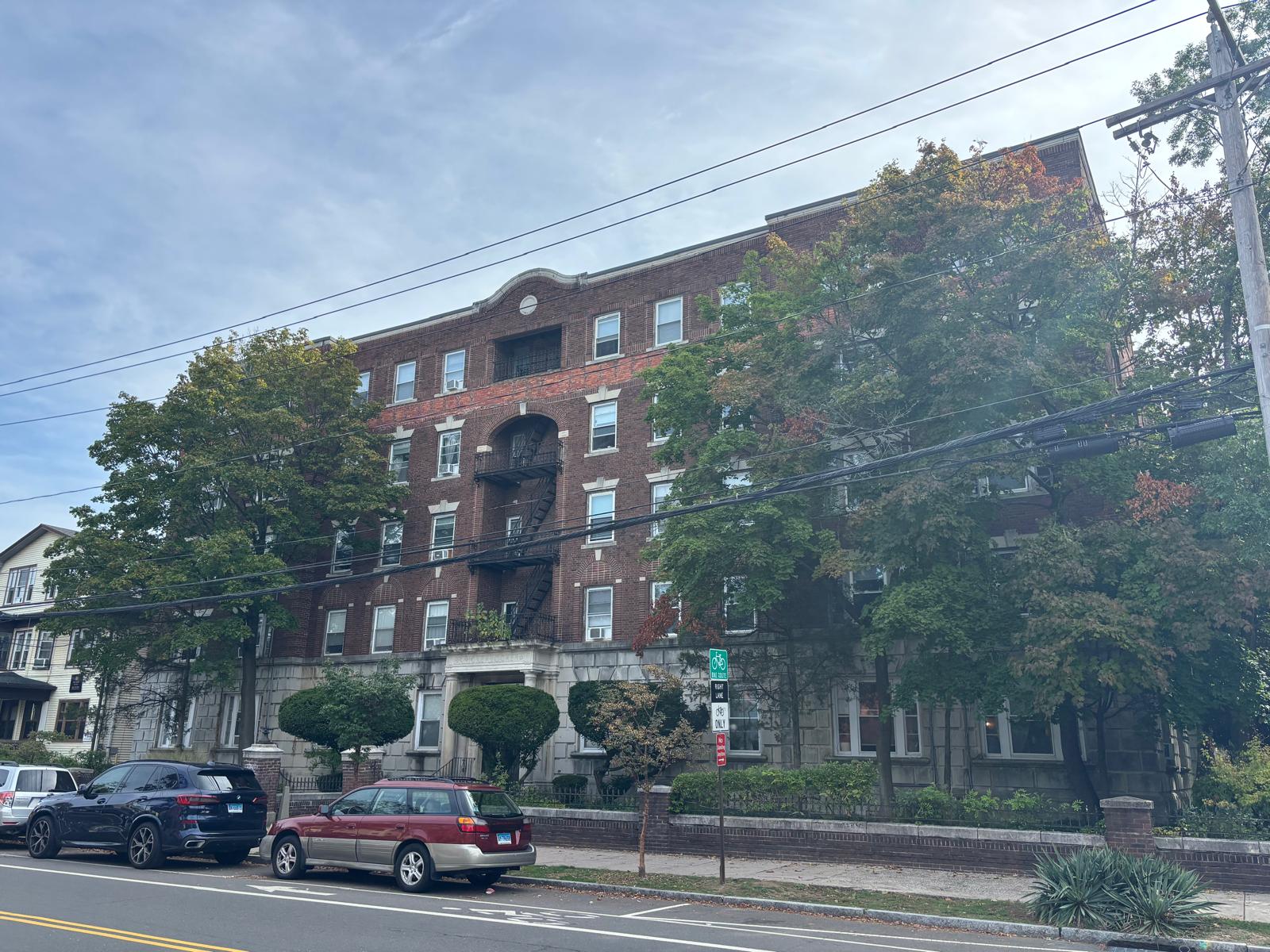
The Knickerbocker Apartments, on the northeastern corner of Orange and Bishop Streets, stands out among the double-deckers common elsewhere in the neighborhood. A five-story, brick apartment building roughly in the shape of an H, it carries an air of old grandeur. Though the brick is dirty in some places and the replaced windows make the building feel a bit more modern, the Greek revival portico, with the name Knickerbocker engraved on it, shows that at the time of its creation, the apartment building was something fancy, something special. Constructed around 1921, the Knickerbocker indeed housed more upper-class residents of the neighborhood, and today continues to be home to Yale affiliates and other New Haveners. Because it largely hasn’t been remodeled, the Knickerbocker retains some of its old charm and glory, including an intricately designed lobby, condemned dumbwaiter shafts, and an old elevator.
Previously, the site housed the historic Pierrepont B. Foster house, which was constructed in 1851. The house was the Foster family’s home, which was in good shape in 1890, and was accompanied by a barn of poor quality. In 1890, the owners considered selling it to Grace Hospital to renovate and convert into a hospital, but it appears this goal was never realized. The address of the site has changed over the years; in the 1858 city directory, when Foster still lived in the house, the address is only listed as “Orange c Bishop.” In 1911, the property was recorded as 627 Orange St.
From at least 1900-1911, the site was owned by Edward A. Anketell, a lawyer. Anketell was born in 1840 in New Haven and died in 1913; he is buried in the Grove Street Cemetery. It appears that though the site was owned by Anketell, the Foster house remained onsite until the construction of the Knickerbocker Apartments in 1921. The building permit for the Knickerbocker was acquired on 12/17/1914. A few nearby properties northward on Orange and Edwards Streets remained owned by P.B. Foster Est.
The Knickerbocker building was designed by local architect Jacob Weinstein, who also designed other apartment buildings in similar styles in the East Rock neighborhood, as noted above. It appears that the building was contracted by Pasquale Valente II (though this information comes from the same document which misidentifies the architect of the building, so may not be trustworthy). Valente, it appears, was a real estate mogul in New Haven in the early 20th century, though the other buildings which he commissioned or owned are unknown.
The building was bought at some point in the late 20th century by the Zamkov family; though the specific year is unknown, they have owned it since at least 1974. (Property records do not provide more specific information). Michael Zamkov immigrated from Eastern Europe, where he survived the Holocaust by fighting in the Polish resistance, and while living in New Haven, he and his wife Sylvia bought the Knickerbocker.
The city property records state that the building has changed ownership since then — to Guy T. Iaccarion in 2004 and to Rojame Associates LLC (who currently own the building) in 2005. However, current residents spoke of the building owners as being the third generation of the Zamkov family. They stated that the Zamkov family also owns buildings on Livingstone St. and Whitney Ave. Very little information can be found about Iaccarion or Rojame Associates on Google.
The tenancy of the building has changed over the years. The 1924 city directory, listed under List of tenants, demonstrates the character of the building’s residents after its creation; some were listed as reverends, music teachers, or nurses. The 1930 census also provides a snapshot into the lives of the residents in the building’s first 10 years. Largely, the tenants appear to be older couples in their 50s and 60s, sometimes accompanied by their parents or children. The majority were born in the US, and in New England, spoke English, and worked jobs including as insurance agents, social workers, professors, dentists, and bank clerks. The monthly rent value of most apartments in the building (and they were all—and continue to be—rented) ranged from $65 to over $100. Most apartments are connected to a telephone, according to the New Haven City Directory. Meyer Wurzberg and his wife, Rose, for example, lived in apartment 38 in 1930. Both were born in Connecticut, and Wurzberg worked as a paint wholesale salesman. Though Meyer Wurzberg appears to be a name of Jewish origin, the ethnic makeup of the building was diverse, as the variety in tenant names (again, listed above in the worksheet) demonstrates.
Throughout the 1940s and 1950s, the class and demographic of the building largely remained the same. However, the monthly rental rate of each apartment in the 1940 census had dropped to $50-60, perhaps as an after-effect of the Great Depression.
Now, in 2025, tenants of the building spoke about its character. One tenant thought that the building had deteriorated over the years, though the owners are currently putting a lot of effort into restoration.
One tenant added that she thought the rent for the building (leases last for an entire year) was reasonably priced, that the building has very few vacancies, and that people tend to live in the Knickerbocker for many years. However, families are rare, probably, she said, because there are only two shared washers and dryers in the entire building. Additionally, as noted above, there is no parking associated with the building.
Another tenant said that many residents are grad students or older adults who work at Yale or elsewhere in New Haven. He did not believe that the building had an upper-class quality anymore, though. He has found the rent becoming more expensive recently, though he declined to state specifics. No specific information about rent can be found easily accessible online.
Though both tenants thought that tenants today are of a variety of socioeconomic statuses, they both held the belief that the building used to be “posh” when it was first constructed.
No comprehensive list of tenants today can be found.
The building is located less than a mile from the center of Yale’s campus (considered as the Schwarzman Center) in the East Rock neighborhood, a largely residential neighborhood of double- and triple-family homes, along with some other apartment buildings — from the Knickerbocker, one can walk to Yale in about 10 minutes. East Rock also contains several neighborhood corner cafes, markets, churches, restaurants, such as Atticus Market and Cafe Bravo, all linked through blocks with sidewalks and crosswalks, which presumably indicate that the neighborhood aims to cultivate a welcoming and pedestrian-friendly environment, where neighbors can walk to visit small establishments such as these. Furthermore, East Rock contains East Rock Park and the Rock itself, a well-kept spot of nature that is criss-crossed with trails for easy accessibility. There are a few schools in the East Rock neighborhood, as well, including the Wilbur Cross High School. All of these qualities make East Rock a desirable neighborhood to live in.
The Knickerbocker Apartments were constructed alongside a few other apartment buildings also designed by Jacob Weinstein, including the Belnord and the Cordova apartments. All have a similar Georgian style and are situated within a few blocks of each other. Based on this observation, it appears that in the early 20th century, these buildings served as new, nice apartments for the growing residential neighborhood.
The Knickerbocker apartment building is a general H-shape, with the bottom of the H facing to the south and small courtyards in between the two arms of the H. The building contains 40 apartment units, varying from 1 to 2 bedrooms, with 8 on each floor, off of a central hallway. Sanborn fire maps from the early 1900s show specifically that the central hallway is fireproof and reinforced with concrete.
The first floor has a stone exterior on the Orange and Bishop St. sides, while the rest of the building is brick, generally in a Georgian style. The Greek revival style porch at the front of the building on Orange Street is flanked with Doric columns.
The windows themselves on the building have been replaced, but the brick patterns around them remain. The windows on the second floor facing Orange Street have a Stack Bond Brick Pattern above them, while the first, second, third, and fourth-floor windows around the street sides of the building are done in a Colonial Revival double-hung fashion. The fifth floor windows and windows on the back of the building are unornamented.
Very little has notably changed in the building’s appearance, except that it used to have a Romanesque Revival corbel in between the fourth and fifth floors, as photographs from the 1920s show. Today, the brick appears stripped and exposed.
Additionally, the same photos show awnings over the windows on the building. While no awnings remain today, some windows still have the mechanisms attached to support the awnings.
Interiorally, the building used to have 8 dumbwaiter shafts connecting apartments on each floor. Though the dumbwaiter doors remain in the apartments, the shafts are condemned and cannot be used. The interior aesthetic of the building was important, particularly in the lobby, with marble around the lower part of the walls and around the doorframes of the first floor apartments, ionic columns, gold-colored molding on the ceiling, and tiled floors. Furthermore, the elevator, with its sliding metal grate door, remains intact to this day, though the elevator itself has been updated.
Because the Knickerbocker was built before cars became more widespread, the Knickerbocker does not have parking for its residents. It appears that residents must park on the street or elsewhere, or do not own vehicles.
Ancestry.com Censuses and Vital Information.
1900 Census. Edward Anketell at 627 Orange St. https://www.ancestry.com/search/collections/7602/records/7516285
1930 Census. Meyer Wurzberg at 625 Orange St. https://www.ancestry.com/search/collections/62308/records/39385977?tid=&pid=&queryId=46aeaa0d-94ca-4a62-8e5b-597657cd2e09&_phsrc=lHE15&_phstart=successSource
1940 Census. Arthur Mealia at 625 Orange St. https://www.ancestry.com/search/collections/2442/records/130148452?tid=&pid=&queryId=b42611d2-adde-4742-92af-d8e283310499&_phsrc=lHE18&_phstart=successSource
1950 Census. Max Abeshouse at 625 Orange St. https://www.ancestry.com/imageviewer/collections/62308/images/43290879-Connecticut-141603-0025?rc=&queryId=0a5e8c3c-5498-4855-9810-ed4b5d7d04ae&usePUB=true&_phsrc=lHE22&_phstart=successSource&pId=40168992
Grave of Edward Anketell. https://www.ancestry.com/search/collections/60525/records/72632043?tid=&pid=&queryId=febe8a68-b068-4f9c-88e4-5b652abf5af7&_phsrc=lHE24&_phstart=successSource
1858 U.S., City Directories, New Haven. Pierrepont B. Foster. https://www.ancestrylibrary.com/imageviewer/collections/2469/images/595157?rc=&queryId=2edc8523-e550-4703-96ce-49a2ca7699fa&usePUB=true&_phsrc=IyS130&_phstart=successSource&_gl=1*626k7r*_up*MQ..*_ga*MTUyMzkwNTM1OS4xNzU5NTA4NjAx*_ga_4QT8FMEX30*czZhNzc3MjM1LTI3YzUtNGQ4Zi05OGJjLWZjMzVmMjAzOWViZSRvMSRnMCR0MTc1OTUwODYwMSRqNjAkbDAkaDA.*_ga_LMK6K2LSJH*czZhNzc3MjM1LTI3YzUtNGQ4Zi05OGJjLWZjMzVmMjAzOWViZSRvMSRnMCR0MTc1OTUwODYwMSRqNjAkbDAkaDA.&pId=1251918837
Apartments.com. 625 Orange Street. https://www.apartments.com/625-orange-st-new-haven-ct/xc0qsdn/
Arnold Guyot Dana Archives, New Haven: Old and New. Volume 39. Orange Street 2-A: East Side. New Haven Museum.
p. 13
p. 34-35
FindAGrave.com. Pasquale Amante Valente II. ND. https://www.findagrave.com/memorial/222464592/pasquale-amante-valente
Geni.com. History of Michael Zamkov. ND.
https://www.geni.com/people/Michael-Zamkov/6000000008607846771
Liu, Emily. “The Creation of Urban Homes: Apartment Buildings in New Haven, 1890-1930.” 2006. /https://openyls.law.yale.edu/server/api/core/bitstreams/f890401c-90f8-499c-9c4b-cdd24f4b4482/content
New Haven Building Archive.
The Belnord. 548 Orange St. https://nhba.yale.edu/building?id=344
The Cordova Apartments. 671-675 Orange St. https://nhba.yale.edu/building?id=379
New Haven City Directory. New Haven Museum.
1913, p. 970
1924, p. 1238
1950, p. 81
New Haven Preservation Trust. ND.
Historic Resources Inventory: Orange Street (562-751). https://nhpt.org/orange-street-562-751
Orange Street. https://nhpt.org/orange-street
New Haven Property Records. 625 Orange St.
https://gis.vgsi.com/newhavenct/Parcel.aspx?Pid=11612
Sanborn Fire Insurance Maps, New Haven Museum.
1901. Volume I. Sheet 29. https://collections.library.yale.edu/catalog/11188890
1911. Sheet 22.
1917. Sheet 29.
1923. Volume II. Sheet 285. https://collections.library.yale.edu/catalog/11190119
Saved edits to this building (newest first). Each row is logged when an editor saves changes.
No recorded edits yet.
Researcher
Anya Geist
Entry Created
October 24, 2025 at 5:23 PM EST
Style
Colonial / GeorgianGreek RevivalColonial RevivalCurrent Use
Apartment HouseResidentialEra
1910-1950Neighborhood
East RockYear Built
1921
Architect
Jacob Weinberg
Roof Types
FlatDimensions
120 x 90
Owner
Rojame Associates LLC
Ownernishp Type
2
Client
Pasquale Valente II
Historic Uses
Apartment HouseResidentialComments
You are not logged in! Please log in to comment.