Berger Apartments 135
135 Derby Avenue, New Haven, CT 06511
The Berger Apartments at 135 Derby Avenue stand as a large five-story brick structure that once operated as the Berger Brothers Corset Factory. The site’s plain masonry walls, repeating window bays, and flat roofline reflect a design that is rooted in industrial utility and functionality rather than attempting to appear ornamental or aesthetic. Today, the building’s former shop floors have been converted into 144 apartments for senior and differently abled residents. This drastic change in the building’s use poses as an example of the adaptive reuse of structures in New Haven. This reuse also opens the door to a broader narrative of how a structure built for manufacturing outlived its industry and found renewed use as affordable housing.
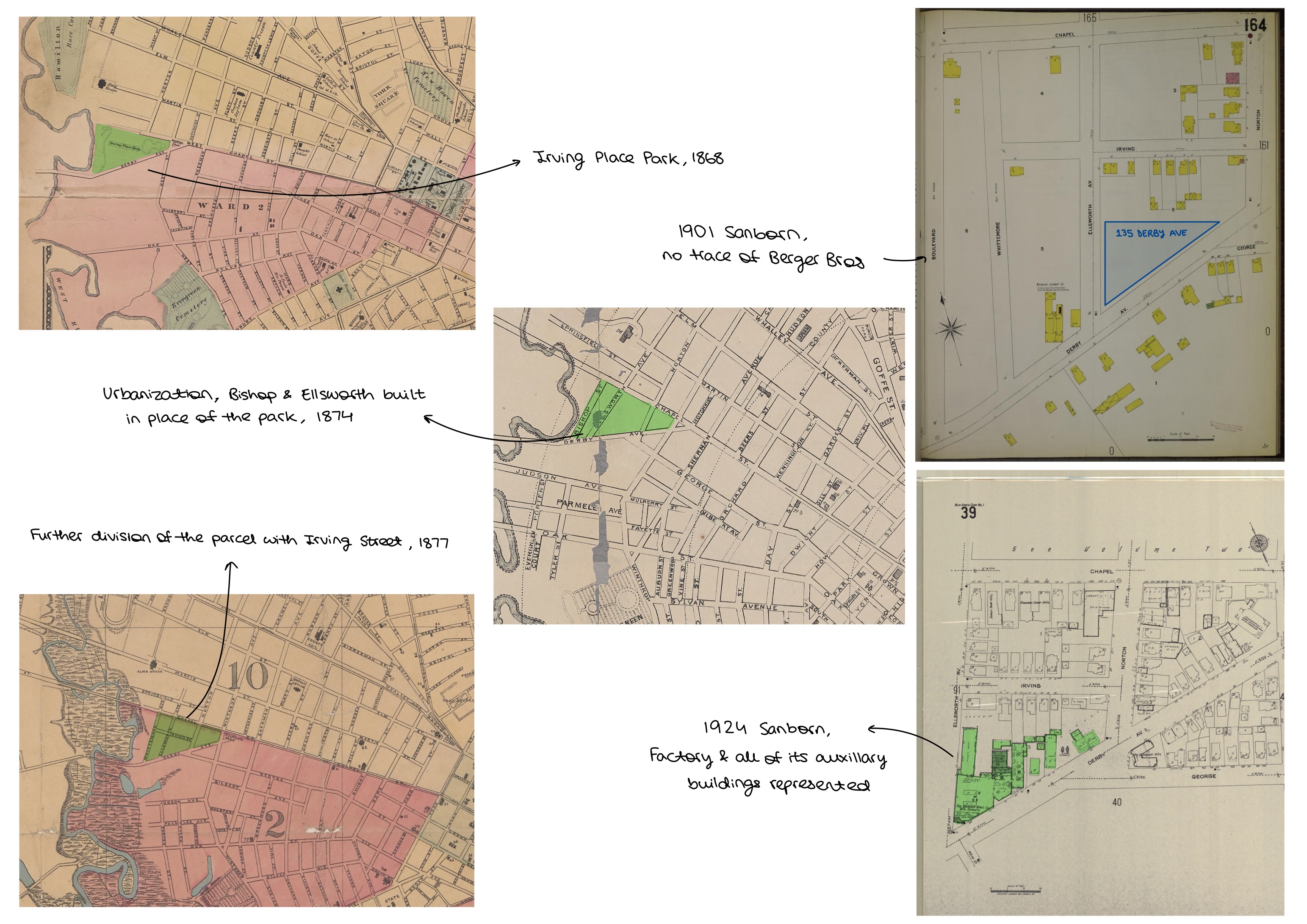
135 Derby Avenue embodies the shifting land use patterns in New Haven’s West River neighborhood. The first gathered map from 1868 records the parcel as Irving Place Park, a small landscaped green space at the edge of the city. By 1874, the park had been cleared out and the area was subdivided into a residential grid, marking its initial transition from open land to an urbanized neighborhood.
Despite the presence of streets in place of the park, the area remained undeveloped through the early 20th century. The 1901 Sanborn Fire Insurance Map shows the corner lot of Derby Avenue vacant while surrounding blocks filled with homes and small businesses. It was only a few years later that the property took on industrial life with the construction of the Berger Brothers Corset Factory, first seen in the 1924 Sanborn Map with all of its auxiliary buildings.
This progression of the site, from park to vacancy to factory, reflects the layered urbanization of the West River. In this way, across three centuries, the site has adorned several roles in the local community, ultimately solidifying its place as one for equitable residential use today.
The site has endured great transformation over the decades, embodying New Haven’s progress from an industrial city to one defined by post-industrial housing needs. Records of the site from 1868 maps highlight its first appearance as the Irving Place Park posing almost as an annexure to the West River Park. In 1874, the park was subdivided by Bishop Street (later renamed Whittemore Avenue) and Ellsworth Avenue as the city expanded westward. By the early 20th century, Sanborn Fire Insurance Maps recorded the site as the Berger Brothers Corset Factory. The enterprise was a major garment manufacturer that employed large numbers of immigrant and women workers, tying the building to histories of industrial labor and expanding economic opportunities for women in New Haven. This employment pattern mirrored a broader regional trend in the New England belt, where garment factories served as some of the earliest wage-labor opportunities for women, albeit often under low-paid and restrictive conditions. In this manner, the enterprise was locally significant by opening up the West River neighborhood to heavy women involvement in industrial labor.
The factory continued to operate under these conditions until the collapse of the garment industry in the mid-20th century left the site behind as a product of deindustrialization. Today, the Berger Apartments stand as a cornerstone of affordable housing in the West River neighborhood, serving predominantly non-White and immigrant populations. In this way, the building has consistently played the role of a refuge for marginalized groups in New Haven, whether previously as a site of industrial employment or today as a provider of housing security.
In the broader context of New Haven, the site illustrates the shifting balance of industry, community, and survival. Beginning as a factory tethered to national fashion markets, today the site has become an accessible residential anchor for one of the city’s most economically vulnerable yet culturally vibrant neighborhoods.
The Berger Apartments are situated on Derby Avenue in the West River neighbourhood of New Haven. This community is composed of affordable housing projects, modest homes, and community institutions. Across the street, the former New Haven Laundry facility is currently being redeveloped into The Monarch Apartments, which mirrors the scale and social mission of Berger by providing additional affordable housing to the local community. In the area surrounding both these complexes, two- and three-storey wood-framed homes with pitched roofs and modest porches create a residential environment more typical of a suburban neighborhood. The presence of the Christian Love Center across the street serves as a reminder of the community institutions that are key to community life.
That being said, the broader urban context highlights the persistent socioeconomic challenges of the neighborhood. The median household income in West River ($29,528) is less than half of the national average, and more than 60% of children here live in poverty, among the highest levels across the nation. The combination of these factors leads to inescapable cycles of systemic poverty that manifest in the shockingly low high school and college graduation rates and surprisingly high crime scores, with levels of homicide and robbery far surpassing national averages. The critical state of West River is especially striking given the presence of Yale, one of the nation’s leading educational institutions, located merely ten blocks away.
Furthermore, the demographics of the neighborhood - with over 55% African American, 20% Hispanic populations, and over 25% foreign-born residents - reveals the major role of immigration in shaping the community. This diversity results in a vibrant cultural mix, but one that exists in the shadow of significant economic strain.
The Berger Apartments are situated within a five-storey masonry structure with a rectangular massing and a flat tar-and-gravel roof. The facade is composed of ordinary red brick laid in a utilitarian pattern, acting as an ode to the building’s industrial origins. The exterior is defined by repeated fenestrations in the form of evenly spaced window openings which emphasize function by illuminating the inside of what was once a bustling industrial operation. The exterior walls are reinforced with tall pilasters, spaced at every ~10 feet, that run the height of the building, serving as divisions to the window bays and structural support for the structure.
Sanborn maps from 1924 and 1973 document the site while it was occupied by the Berger Brothers’ business, listing the presence of a lobby block, power house, and several sheds across the land parcel. While the power house and auxiliary sheds have been removed, the lobby block stands today in an adapted form, serving as the primary egress for the apartments and maintaining continuity between the building’s industrial and now residential phases. On the inside, the factory was originally designed to have wide open-production floors supported by post-and-beam framing to accommodate several sewing machines and assembly lines.
After the boom of the garment industry subsided, the structure was converted into a residential dwelling in 1981. This massive renovation resulted in the addition of several residential partitions, kitchens, and bathrooms, making way for residents to move into the revitalized space. 135 Derby Avenue was subsequently updated again in 2013, to modernize HVAC and accessibility systems throughout the complex. Despite both sets of major renovations, the exterior brickwork and structural form remain largely unchanged, thereby signalling a durable example of industrial vernacular architecture that has adapted to changing community needs.
“135 Derby Ave.” Redfin, 2023, www.redfin.com/CT/New-Haven/135-Derby-Ave-06511/home/54292905.
Bailey, Melissa. “Berger Apartments Sold for $11.2M.” New Haven Independent, 14 Dec. 2012, www.newhavenindependent.org/2012/12/14/berger_apartments_sold_for_11-2m/.
D. A. Sanborn National Insurance Diagram Bureau. Insurance Maps of New Haven, Connecticut. Sanborn Map Company, 1924, collections.library.yale.edu/catalog/11190119.
---. Insurance Maps of New Haven, Connecticut. Sanborn Map Company, 1973, collections.library.yale.edu/catalog/11199137.
---. Insurance Maps of New Haven, Connecticut. Sanborn Map Company, 1901.
Gambini, Hanna Snyder, and Hanna Snyder Gambini. “Former New Haven Laundry Facility Sold for “the Monarch” Affordable Housing Project.” Hartford Business Journal, 8 July 2024, hartfordbusiness.com/article/former-new-haven-laundry-facility-sold-for-the-monarch-affordable-housing-project/.
Hardy, Alyssa. “Fashion History Lesson: The Origins and Recent Strides of the U.S. Garment Labor Movement.” Fashionista, 28 Mar. 2023, fashionista.com/2023/03/garment-labor-laws-movement-united-states-fashion-history.
Lyman, Edward. Benham’s New Map of the City of New Haven. Edited by S. Butler, Civil Engineer, 1874.
Monroe Group. “Berger Apartments - Monroe Group.” Monroe Group, 11 Mar. 2025, www.monroegroup.com/property/berger-apartments/.
Plan of the City of New Haven. 1868.
Schiller, Dr Andrew. “West River, New Haven, CT 06511, Neighborhood Profile.” Neighborhoodscout.com, NeighborhoodScout, 29 Mar. 2019, www.neighborhoodscout.com/ct/new-haven/west-river.
Steele Properties LLC. “Berger Apartments - Steele Properties LLC.” Steele Properties LLC, 25 July 2023, www.steelellc.com/property/berger-apartments/.
“West River.” Homes.com, 2025, www.homes.com/local-guide/new-haven-ct/west-river-neighborhood/.
“West River Neighborhood in New Haven, Connecticut.” City-Data.com, 2025, www.city-data.com/neighborhood/West-River-New-Haven-CT.html.
Saved edits to this building (newest first). Each row is logged when an editor saves changes.
No recorded edits yet.
Researcher
Aarav Gandhi
Entry Created
October 19, 2025 at 11:49 AM EST
Historic Name
Berger Brothers Corset Factory
Style
Industrial VernacularCurrent Use
ResidentialMultiple Unit DwellingApartment HouseAffordable HousingEra
1910-1950Neighborhood
West RiverYear Built
1901-1924
Current Tenant
Residential Tenants
Roof Types
FlatThreats
DevelopmentNeglect / DeteriorationFlood RiskDimensions
96,750
Owner
Steele Properties LLC
Ownernishp Type
2
Client
Berger Brothers Co.
Historic Uses
ManufacturingIndustrial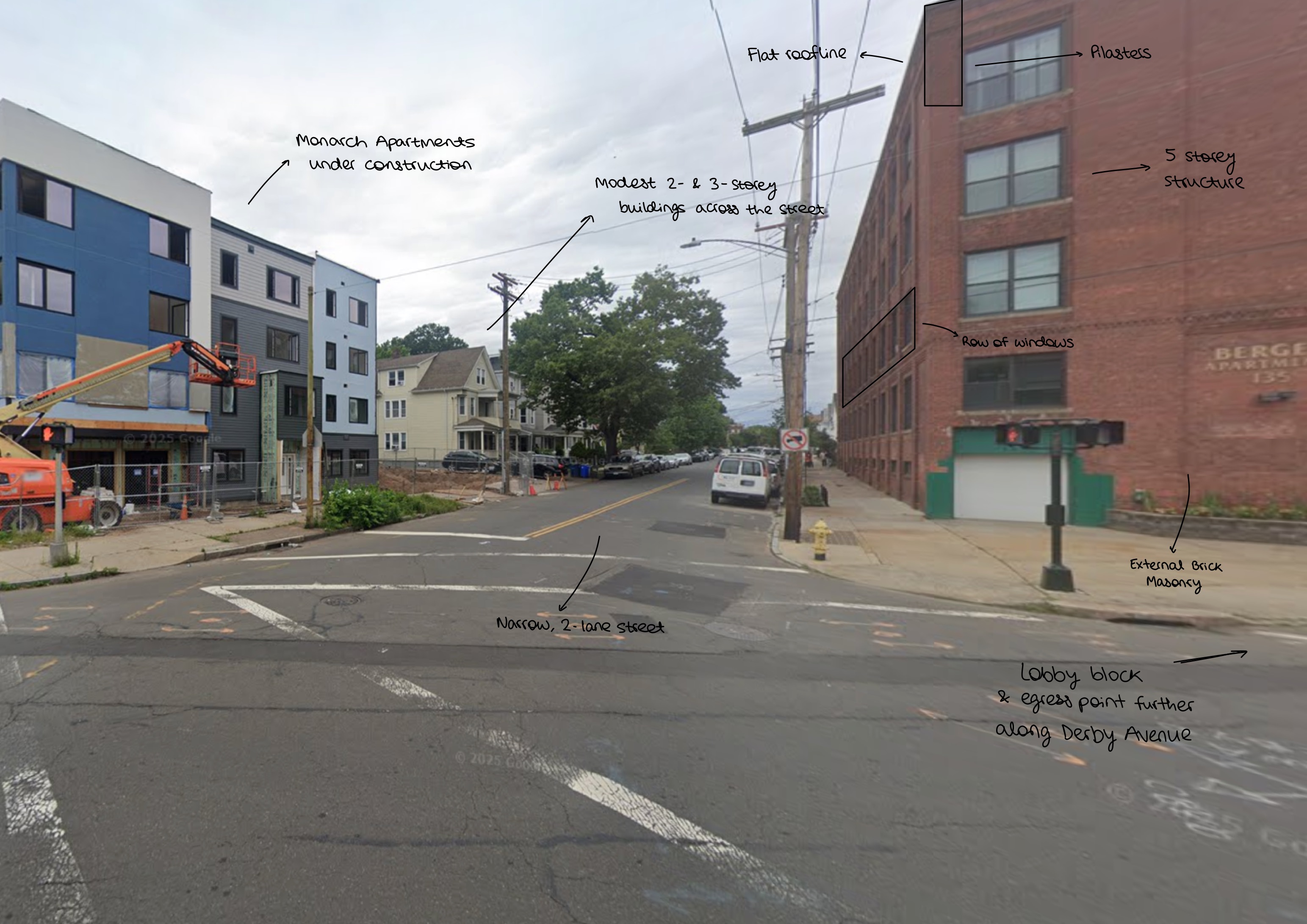
Comments
You are not logged in! Please log in to comment.