50 Elm Street
50 Elm St, New Haven, CT 06510
50 Elm Street sits in an urban area of New Haven on the southeast corner of the Elm St. and Orange St intersection. The main entrance faces Ferrucci Ltd, a fine men’s clothing store located at the base of a four-story brick building on the northeast corner of the intersection. To the east of 50 Elm Street is a paid parking lot and to the west, across Orange St., is an empty lot surrounded by green netting which was an office of Webster Bank until 2017. Diagonally across the intersection of Elm St. and Orange St. is 59 Elm St., also known as the Bullard Building, a wide, imposing 5-story office building. Behind 50 Elm St. is another parking lot, this one reserved for employees at 50 Elm St. and at the New Haven Legal Assistance Association located at 205 Orange St. Further to the west are more office buildings and the Church St.-facing side of the New Haven Green, and to the east is a mix of multi-family housing, retail, and office space before the flow of buildings is interrupted by the wide intersection of Elm St. and State St. North and south of 50 Elm St., along Orange St., is again a mix of multi-family housing, retail, and office space. While the building is located near some services and retail (i.e. Fashion Nail & Spa at 41 Elm St, or K&G Corner Deli at 169 Orange St.), it seems that most of the foot traffic in the area is employees at nearby offices. There is much more car traffic than foot traffic, with a constant stream of cars heading east on the one-way Elm St. toward the Elm St and State St. intersection. Though the building sits across from a lot that has sat empty since 2020, its position on the seemingly recently paved section of Elm Street and proximity to the New Haven Green and surrounding commerce underscores the value of the lot.
Present: Law Offices of Richard P. Silverstein (present)
Present: Law Offices of Jamie E. Alosi (present)
Present: Mitchell Studio (present)
~ 2016 - Present: Downtown News and More (approx. 2016 - Present) (listed as 231 Orange Street)
~ 2014 - 2020: Aldrich Pilates (approx. 2014 - 2020)
~ Early 2010s - Present: Law Offices Of Paul V. Carty (early 2010s to Present) (listed as 233 Orange Street)
~ Early 2010s - 2016: Orange Street Hairstyles (Early 2010s to 2016) (listed as 231 Orange Street)
~ Mid 2000s - Early 2010s: Phil’s Hairstyles (Mid 2000s - Early 2010s) (listed as 231 Orange Street)
~ 1980s: Amalgamated Clothing Workers of America (1980s)*
~ 1980s: Amalgamated Services & Allied Industries Joint (1980s)*
~ 1980s: Philip W. Ball Associates (1980s)*
~ 1980s: EZ Method Driving School (1980s)*
~ 1980s: Franke Albert W. Associates Inc (1980s)*
~ 1960s: Nodelman J, MD (1960s)**
~ 1960s: Cox F G & Co acct (1960s)**
~ 1960s: Heidtman Helen Mrs. Franzman M M Co Laundry (1960s)**
~ 1960s: McGuire R F Dentist (1960s)**
~ 1960s: Sherwin-Williams Co Paint (1960s - at least 1973)**
~ Mid 1800s: Henry C. Babcock (Mid 1800s)***
~ Mid 1800s: James Fordham (saddler) (Mid 1800s)***
~ Mid 1800s: Lyman Ives (Mid 1800s)***
~ Mid 1800s: Stiles Mansfield (carriage makers) (Mid 1800s)***
~ Mid 1800s: John McLagon (molder) (Mid 1800s)***
From the 1850s to mid 1950s, the building address was listed as 24 Elm Street. I was not able to find tenants at this address in any directories I consulted during this time period, including the Price and Lee City Directories in 1899, 1900, 1901, and 1914. I was also not able to find tenants at this address from the 1980s to early 2000s from my online research or conversations with present tenants.
* No start and end years listed in the 1982 New Haven Directory.
** No start and end years listed in the 1963 New Haven Directory.
*** If we are to assume that the lot was addressed 24 Elm Street from 1840-1849, as marked on the 1886 Sanborn Map. Also, no start and end years were listed in 1840-1849 New Haven CT Directory Assistant.
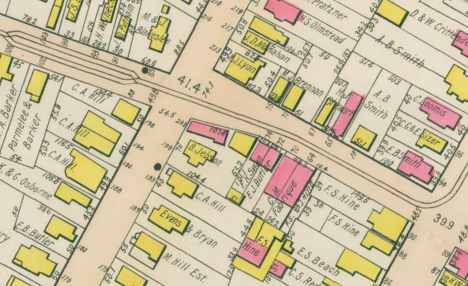
During the 17th-century New Haven was home to the Quinnipiac tribe, who lived in wigwams and longhouses near the water in the warm months and moved inland during the winter. The Quinnipiac were displaced by English settlers in 1638 and relocated to a nearby reservation. In the English settlers’ Nine Square Plan for New Haven, 50 Elm Street sat on the east end. The area’s proximity to the New Haven Green made the land valuable commercial space by the mid-1800s and perhaps earlier. In the 1800s, the land was home to a four-story Second Empire style building before, in a move likely financed by businessman and publisher John Day Jackson, the present day 50 Elm Street building took its place. While the Second Empire style building may have met both commercial and residential needs, the current day 50 Elm Street building has been strictly a commercial center since its origination. This current building has withstood significant turnover in its vicinity, such as but not limited to the demolition of the Benedict Memorial Presbyterian Church to its immediate east, the demolition of Webster Bank across Orange St., and the demolition of the broadcasting studio to its immediate south. (“A plan of the town of New Haven”—James Wadsworth 1748, “The City of New Haven Connecticut” 1879 by O.H. Bailey and J.C. Hazen, Sanborn Fire Maps, “New Haven…umm, what about it?”)
50 Elm Street has served the role of a business center for most of its history. Its location in the heart of downtown New Haven, just two blocks from the New Haven Green, has made it a valuable commercial space since at least the mid-1800s and likely earlier. In the mid-1800s, the businesses that operated out of what was then a four-story Second Empire style building included James Fordham’s saddlery, John McLagon’s molding company, and Stiles Mansfield’s carriage-making business. The creation of the contemporary 50 Elm Street in the early 1900s ushered in new tenants, including the Sherwin-Williams Co Paint store, McGuire Dentistry, Heidtman Laundry, Cox & Co Accounting, and Nodelman medical practice. The 1980s again ushered in a new wave of tenants, including the Amalgamated Clothing Workers of America, Amalgamated Services & Allied Industries Joint, EZ Method Driving School, Philip W. Ball Associates, and Franke Albert W. Associates. The building’s transition from good-based businesses in the 1800s and early 1900s to service-based businesses has persisted into the present day. From the mid-2000s to the early 2010s, it housed hairstyling businesses such as Phil’s Hairstyles and Orange Street Hairstyles, and from 2014 to 2020 it was home to Aldrich Pilates. The building is presently home to Downtown News and More, the Law Offices Of Paul V. Carty, Mitchell Studio, the Law Offices of Richard P. Silverstein, and the Law Offices of Jamie E. Alosi. 50 Elm Street has been host to a wide range of tenants over the years, from a saddlery to a union to an architecture firm. The site’s social history reflects its enduring role as a commercial center in downtown New Haven that continues to adapt to the shifting needs of the city’s residents.
50 Elm Street sits in an urban area of New Haven on the southeast corner of the Elm St. and Orange St intersection. The main entrance faces Ferrucci Ltd, a fine men’s clothing store located at the base of a four-story brick building on the northeast corner of the intersection. To the east of 50 Elm Street is a paid parking lot and to the west, across Orange St., is an empty lot surrounded by green netting which was an office of Webster Bank until 2017. Diagonally across the intersection of Elm St. and Orange St. is 59 Elm St., also known as the Bullard Building, a wide, imposing 5-story office building. Behind 50 Elm St. is another parking lot, this one reserved for employees at 50 Elm St. and at the New Haven Legal Assistance Association located at 205 Orange St. Further to the west are more office buildings and the Church St.-facing side of the New Haven Green, and to the east is a mix of multi-family housing, retail, and office space before the flow of buildings is interrupted by the wide intersection of Elm St. and State St. North and south of 50 Elm St., along Orange St., is again a mix of multi-family housing, retail, and office space. While the building is located near some services and retail (i.e. Fashion Nail & Spa at 41 Elm St, or K&G Corner Deli at 169 Orange St.), it seems that most of the foot traffic in the area is employees at nearby offices. There is much more car traffic than foot traffic, with a constant stream of cars heading east on the one-way Elm St. toward the Elm St and State St. intersection. Though the building sits across from a lot that has sat empty since 2020, its position on the seemingly recently paved section of Elm Street and proximity to the New Haven Green and surrounding commerce underscores the value of the lot.
The earliest depiction of 50 Elm Street I identified, from O.H. Bailey and J.C. Hazen’s rendering of New Haven in 1879, indicates that 50 Elm Street originally was a four-story Second Empire style building. In approximately 1900 and in a move likely financed by businessman and publisher John Day Jackson, the building was replaced with the current 50 Elm Street structure, with two stories above ground and an unfinished basement. The new 50 Elm Street exterior is largely modernist with minimal ornament, yet enough ornament to portray the importance of the structure. A stone, precast concrete, and brick facade encases the building’s wood balloon framing, which, coupled with its wide base and simple, rectangular prism shape, contributes to a sense of 50 Elm Street’s heartiness and durability. The first level, in particular, cladded in a gray stone, contributes to its authoritative presence. Yet, despite the structure’s dominant characteristics, 50 Elm Street’s architects still felt the need to affirm its role in downtown New Haven commerce and relation to nearby, often taller and more ornamental, office buildings. The architects achieved this by incorporating a wide three-tiered parapet on the Orange Street side of the building, decorative stones in the shape of a downward-pointing arrow in the beige brick on either side of the second-floor windows, and cast-iron early 20th-century light fixtures on either side of the main entrance, which is set back by two feet from the street. While the building’s dominance at just two stories is visually impressive, its unevenly spaced windows and the leftward skew of its parapet create a sense of awkwardness. The peak of the building's parapet and the skinny window just below it imply that this point should serve as the middle of the exterior, yet the building extends beyond, leading there to be five windows to the right of the parapet and just three to the left. This awkwardness undermines 50 Elm Street’s otherwise convincing projection of power and durability. (In-Person Observation, Sanborn Fire Maps, “The City of New Haven Connecticut” 1879 by O.H. Bailey and J.C. Hazen, New Haven, CT Online Assessment Database)
“Aerial survey of Connecticut 1934 photograph 04887.” Fairchild Aerial Survey Co., Connecticut Air National Guard, and Connecticut State Planning Board. 1934. https://cslib.contentdm.oclc.org/digital/collection/p4005coll10/id/8273. Bailey, O.H. and J.C. Hazen. “The city of New Haven, Conn.” Boston: 1879. https://collections.library.yale.edu/catalog/15827455. Cody, MJ. “1840-1849 New Haven CT Connecticut Directory Assistant.” Internet Archive, 2017. Accessed October 5, 2023. https://archive.org/details/18401849NewHavenDirectoryAssistant/page/n263/mode/2up. Google Maps. “50 Elm Street.” Accessed October 1, 2023. https://www.google.com/maps/@41.307614,-72.922676,3a,75y,161.56h,88.54t/data=!3m 6!1e1!3m4!1ssqhJbu4fc-WgliEB2E9SEA!2e0!7i16384!8i8192?entry=ttu. Leeny, Robert J. “Register 200th anniversary: John Day Jackson knew every bit of business.” New Haven Register. December 4, 2012. https://www.google.com/search?q=chicago+style+newspaper+article+online&oq=chicag o+style+newspaper+article+online&aqs=chrome..69i57j0i22i30j0i390i650l3.4626j0j7&so urceid=chrome&ie=UTF-8. Wadsworth, James “A plan of the town of New Haven.” NY: Charles Currier, 1748. https://collections.library.yale.edu/catalog/15952287. “New Haven Directory.” New Haven: Price & Lee Company, 1963, Vol. 123. “New Haven…what about it?” Yale School of Nursing. Accessed October 6, 2023. https://nursing.yale.edu/sites/default/files/new_haven_history.pdf. “Residential and Business Listings for New Haven Connecticut.” Johnson Publishing Company, 1983. Sanborn Map Company. “Insurance Maps of New Haven Connecticut.” New York: Sanborn Map Company, 1923. Sanborn Map Company. New Haven, New Haven County, Connecticut, 1886. https://yalemaps.maps.arcgis.com/apps/webappviewer/index.html?id=1668098ec0054b3 39e72fb054cf3ab3d#. Sanborn Map Company. New Haven, New Haven County, Connecticut, 1901. https://yalemaps.maps.arcgis.com/apps/webappviewer/index.html?id=1668098ec0054b3 39e72fb054cf3ab3d#. Sanborn Map Company. New Haven, New Haven County, Connecticut, 1911. https://yalemaps.maps.arcgis.com/apps/webappviewer/index.html?id=1668098ec0054b3 39e72fb054cf3ab3d#. Sanborn Map Company. New Haven, New Haven County, Connecticut, 1924. https://yalemaps.maps.arcgis.com/apps/webappviewer/index.html?id=1668098ec0054b3 39e72fb054cf3ab3d#. Sanborn Map Company. New Haven, New Haven County, Connecticut, 1973. https://yalemaps.maps.arcgis.com/apps/webappviewer/index.html?id=1668098ec0054b3 39e72fb054cf3ab3d#.
Saved edits to this building (newest first). Each row is logged when an editor saves changes.
| When | Editor |
|---|---|
| Apr 19, 2026, 8:10 PM ET | sasha.ranis |
| Apr 19, 2026, 8:07 PM ET | sasha.ranis |
Researcher
Will Sheehy
Last Updated
April 19, 2026 at 8:08 PM EST by sasha.ranis
Style
ModernistCurrent Use
Law OfficesServices (ex. tax prep, travel agency)Era
1860-1910Neighborhood
Downtown and Town Green DistrictYear Built
1900
Current Tenant
Law Offices of Richard P. Silverstein; Law Offices of Jamie E. Alosi; Mitchell Studio
Roof Types
FlatStreet Visibilities
Yes
Threats
None knownNeglect / DeteriorationDimensions
135ft x 42ft x 24ft
Street Visibilities
Yes
Owner
AFLP LLC (sold to AFLP LLC on 12/1/2010)
Ownernishp Type
Private
Client
The building was likely financed by John Day Jackson, a New Haven businessman and publisher. His name is listed on the building in the 1911 Sanborn Maps.
Historic Uses
ResidentialCommercial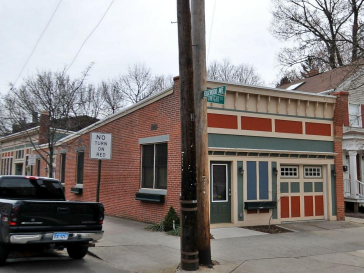
Comments
You are not logged in! Please log in to comment.