Planned Parenthood - New Haven Center
345 Whitney Avenue
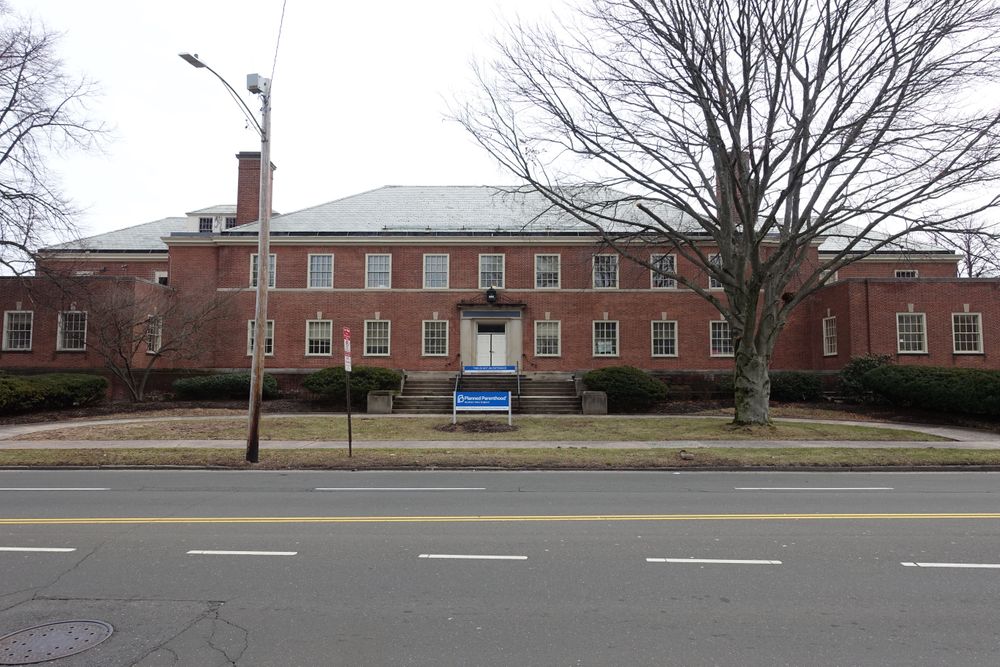
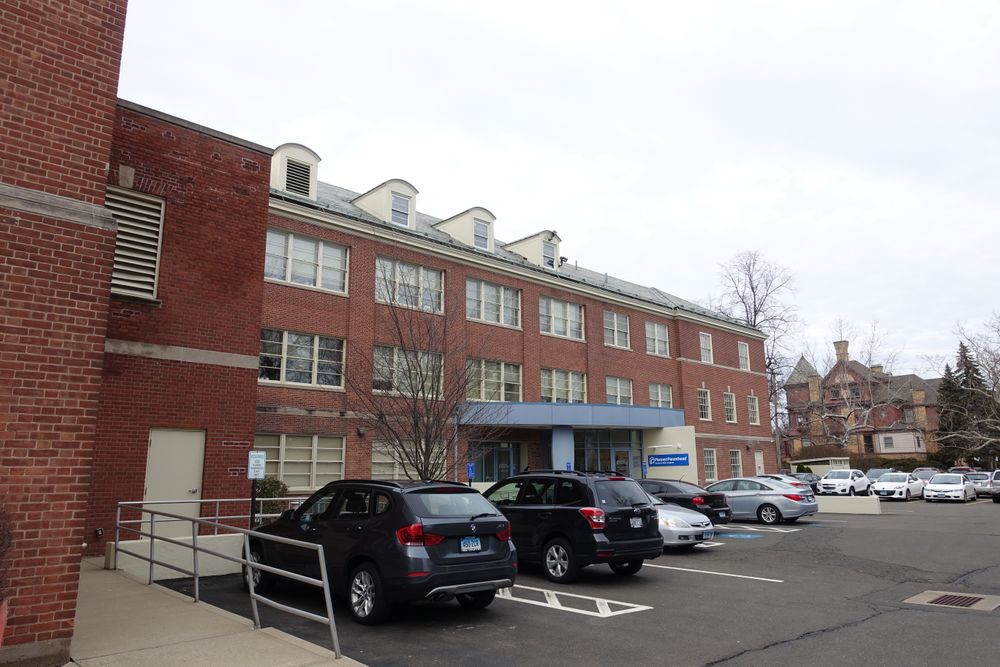
A 2 ½ story colonial revival style brick building with subtle decorations above the first floor windows and front door. This building is currently occupied by Planned Parenthood, an organization that offers sex education and health services.
From the street, New Haven’s Planned Parenthood clinic does not look clinical at all. Its façade faces the entire block of Whitney Avenue between Edwards and Lawrence Streets. A monumentally wide Colonial Revival red brick artifice, two stories high, perfectly symmetrical, and with meticulously manicured landscaping, Planned Parenthood looks more like a Colonial mansion than a health center. The front steps and door of the building are blocked by a sign that
reads “This is not an entrance. Park and enter from Edwards Street.” From the rear entrance at the parking lot, the clinical nature of the building reveals itself. The entrance to the clinic has a glass window through which to speak to scrubs-clad nurses and receptionists. The linoleum floors and countertops are freshly sanitized with bleach, contrasting the exterior of the building which, although clean and well maintained, looks rough, old.
The history of 345 Whitney Avenue, however, explains this seeming incongruity between the exterior and interior of the building. Built in 1951, the building has a history of institutional use focusing on healthcare and scientific research that naturally developed into its use today.
1952-1973: Connecticut Hospital Service, Inc. (later called Blue Cross of Connecticut)
1973-2001: Sigma Xi, The Scientific Research Society of North America, Inc.
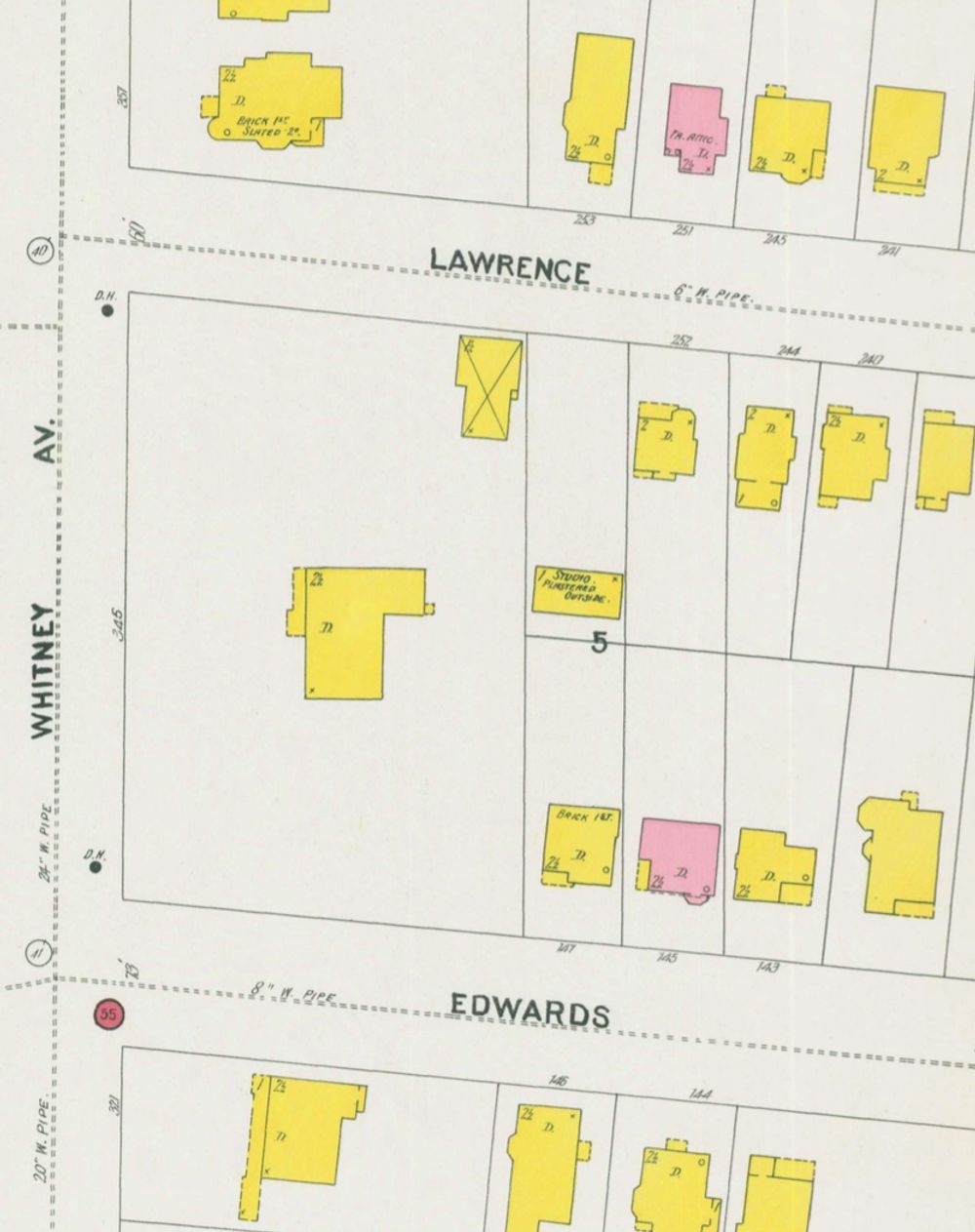
The lot on Whitney Avenue between Edwards and Lawrence streets was originally home to two domestic buildings (Sanborn Map Company). The larger, Whitney Avenue-facing home was built in 1887 W.E. Downes (Dana Collection Volume 62, File 129). Little is known about the smaller, Lawrence Street-facing home. Downes built his modest house on the block next to the grand Stephen Whitney Estate (Sanborn Map Company). Downes’ two children, John I.H. Downes and Catherine J. Whiting lived in the house until it was demolished in 1938 (Ancestry). John I.H. Downes was a librarian at the Yale School of Fine Arts. The Dana Archive at the New Haven Museum includes interior and exterior photographs of the house at 345 Whiney Avenue in 1937, shortly before it was demolished, but the caption of the photo does not indicate why the house was demolished. The lot sat vacant from 1938 until 1949 when construction on the Harold H. Davis building began.25 This is likely because of a lack of development in this area of Whitney Avenue during the period. The surrounding buildings are mostly historic homes, with the exception of the Brutalist style Whitney Fire Station across the street, built in 1962.
The insurance company Connecticut Hospital Service, Inc (Sanborn Map Company). commissioned Harold H. Davis, a local architect, to build a new headquarters on a vacant lot on Whitney Avenue (Hudnall). Dwight Building Company completed construction on the Colonial Revival structure in 1951. During this period of use, the building was a social monument to Connecticut’s great insurance industry. Connecticut Hospital Service, Inc. was the sole tenant of the building until 1973, when part of the office space was rented out to The Society of Sigma Xi, who then moved their national headquarters into the building (Hudnall). Sigma Xi was founded in 1886 as an honorary scientific society for students who showed extraordinary scientific ability (Hudnall). The society is still active today, encouraging scientific research through grants (Sigma Xi). Through the 1970s, the building was occupied by both Connecticut Blue Cross (formerly Connecticut Hospital Service, Inc.) and Sigma Xi, as well as other small offices which housed investment groups, a medical library, and dentists (New Haven City Directory 1976). By
this time, the building promoted scientific achievement and financial strength. By 1981, Connecticut Blue Cross had left the building (New Haven City Directory 1981) and it was officially purchased by Sigma Xi in 1989. Sigma Xi continued to occupy the building, renting out space to other small offices, including the American Scientists, Centennial Industries, and various investment and management services (New Haven City Directory 1985). By the 1990s, Sigma Xi no longer occupied the building, but rented it out to various small tenants, including dental, medical, law, and financial offices (New Haven City Directory 1993).
Planned Parenthood of Southern New England purchased the building for $1.29 million in 2001 (City of New Haven Online Tax Assessors Database). Planned Parenthood moved into the space in 2003 after beginning renovations to convert a significant portion of the building into a clinic. For several years, Planned Parenthood continued to rent office space. 2006 tenants include the Anti-Defamation League, Commonfund (a nonprofit investments management group), and Financial Investors Trust (New Haven City Directory 2006). These tenants brought the building from its history of medical, scientific, and financial industries into a more explicitly activist, nonprofit sphere, mimicking the function of the building’s new, non-profit owner, Planned Parenthood.
Today, Planned Parenthood is the sole tenant of the building. 345 Whitney Avenue is home to both the New Haven clinic, as well as the administrative offices of Planned Parenthood of
Southern New England, which services 17 Planned Parenthood clinics in Connecticut and
Rhode Island (Planned Parenthood of Southern New England).
By converting the space into a nonprofit clinic with the mission to serve everyone, Planned Parenthood has significantly changed the social function of the site. The building originated as private office space for a major insurance corporation, Connecticut Hospital Service, Inc. Under ownership of Sigma Xi, the building was only accessible during office hours. More of the public was able to engage with the building when it became a multi-use office space as more businesses brought their clients inside. As Planned Parenthood, however, the building welcomes all people, particularly people without access to health insurance and people seeking abortions and other services, from the greater New Haven area, engaging with a public of many genders, races, and classes, contrasting starkly with the clientele for whom the building was commissioned, white-collar white men.
The building has also become a site for protests, some for and some against Planned Parenthood. The building is also opened to Planned Parenthood volunteers on Wednesday evenings. Activities include stuffing information filled folders and creating birth control care packages.
345 Whitney Avenue sits in the center of the Whitney Avenue Historic District, a neighborhood on the National Register of Historic Places since the 1980s. The building itself is not on the Register, but it was “inadvertently classified as contributing” to the district until 1989, when the National Register corrected for the fact that its construction date is outside of the district’s defined period of significance, 1840-1938.
Still, the building reflects the nature of the district: “a well-preserved collection of late 19th and early 20th-century residential styles in New Haven (Devlin and Clouette).” 345 Whiney Avenue is surrounded by Queen Anne, Shingle, Colonial Revival, and Tudor revival homes, evidence of early suburbanization by upper-class residents of the city. Whitney Avenue was the first street of the district, a turnpike built in 1798, leading from New Haven northwest to Hartford. The street was named after Eli Whitney, the great industrialist of New Haven, and home to the Whitney Arms plant, today the site of the Eli Whitney museum (Dana Collection). Aside from a few large farms and estates, the area was not developed until after the Civil War when the neighborhood became mostly residential, attracting upper and middle-class residents for its natural setting near to East Rock Park and its large, but still affordable lots (Devlin and Clouette).
Both at the time of 345 Whitney’s construction and today, the area of Whitney Avenue has been a mixed commercial and residential neighborhood. The Planned Parenthood clinic that occupies the building today is surrounded most by residential houses and apartments, in addition to the New Haven Fire Department Whitney Station, a massage parlor, and several medical offices.
345 Whitney Avenue is an excellent example of the features of the Colonial Revival style. The steel frame of the building is covered in red brick,1 combining an early New England aesthetic with modern materials.
The façade is symmetrical, evoking the rational order and the financial power of the insurance company it was built to house, Connecticut Hospital Service, Inc. The white wood double doors at the center of the façade are bordered by fluted Doric pilasters. Above the double-doors is a six-paneled transom and an entablature crowned by a cornice. The interior of the entablature has been painted dark blue. On top of the cornice is an iron decorative element with a box that features the building address (345), rising above the door.
A wide set of concrete steps leads up from the sidewalk of Whiney Avenue to these double doors, made grander by their concrete enclosure. These steps are currently unused, as the double-door entryway of the building is closed. The main entrance of the building is through the parking lot accessible via Edwards St. A sign, installed by Planned Parenthood, stretches across the top step, reading “This is not an entrance.” In front of the steps, a sign labels the building as Planned Parenthood of Southern New England.
Two features in particular emphasize the building’s symmetry. The first is its fenestration. At the center of the façade, the double doors mark a symmetry that is reinforced by the windows, laid out in a 9-bay façade. The windows framed in white painted wood, and each contains a four by four wooden muntin holding in the glazing. Above the center of each of these first-floor windows is a lintel, with a white keystone within a red brick flat arch. These keystones lead the eye up to the second story of windows, all nine topped by flat brick arches without a keystone. The building’s symmetry is also enhanced by its two brick chimneys. They frame the central segment of the façade and the hip roof which rises above it. The hip roofline has a simple cornice.
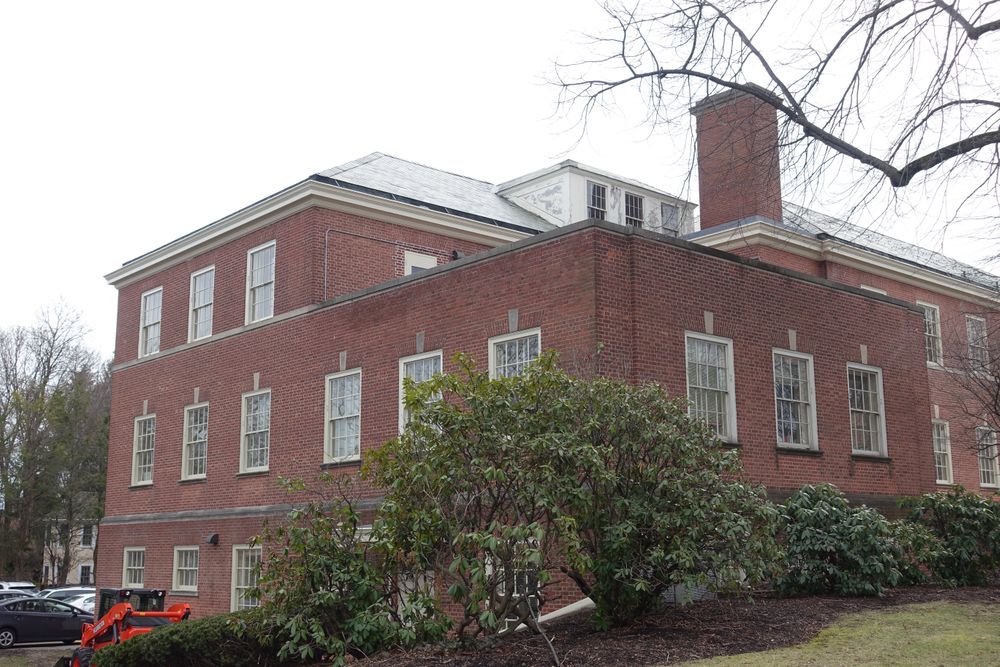
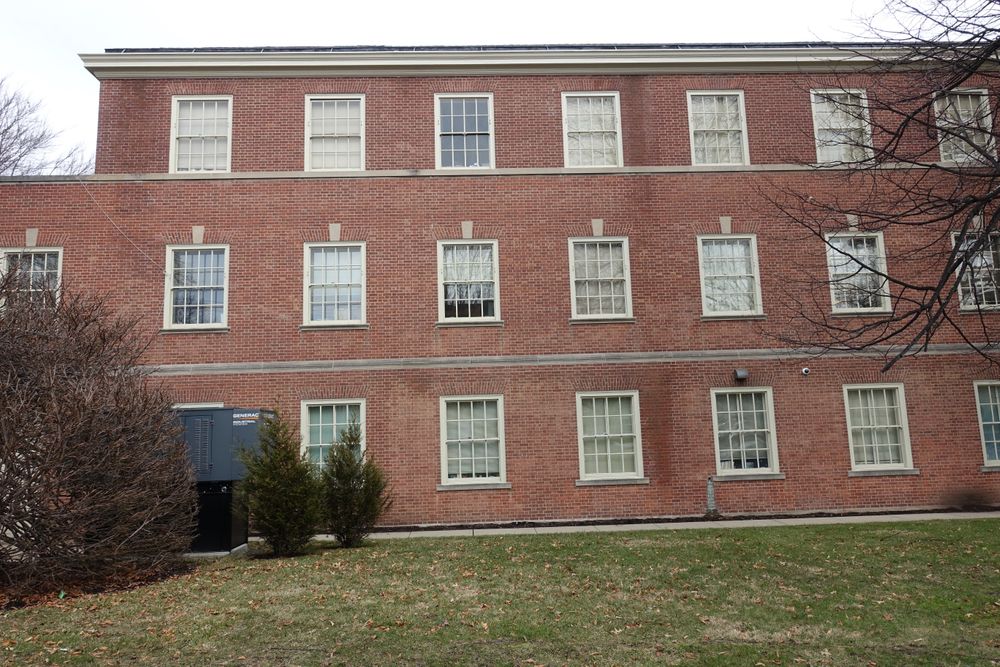
The two wings to the south and north sides of the façade are set behind these two chimneys. The Sanborn map updated to 1961 makes this building structure legible. The two wings have the same window pattern and roof structure as the central structure. On both sides, there is a large dormer, painted white with two windows. Because the building is set on an incline, at the rear of the building, there is a third line of windows, where there is a basement at the front of the building. From the rear, the building loses the symmetrical effect of its façade. From this viewpoint, we can see the true L-shape of the structure, evident in the Sanborn map updated to 1961. Additionally, from the rear, we see four small dormers on the central part of the building’s roof, as well as the modern entrance installed by Planned Parenthood when the organization converted the space into a clinic beginning in 2001. This entrance is composed of two cream concrete walls, a blue steel overhang, and a column that frames the glass double doors. This rear entrance is accessible by wheelchair via a ramp and handrails. The modern appearance of this entrance contrasts with the Colonial Revival red brick of the rest of the building. One door leads to the clinic, the other to the administrative offices of Planned Parenthood of Southern New England.
The interior space of the clinic has a medical, hospital-like appearance, with linoleum floors and plastic chair rail, furniture, etc. The administrative offices to the other side are equally incongruous with the Colonial exterior of the building, lacking molding or other interior elements associated with Colonial style buildings and revealing, instead, the stripped appearance of a midcentury office building.
1. National Register of Historic Places Continuation Sheet. December 2, 1988. https://npgallery.nps.gov/GetAsset/b1be73a9-b320-447c-b92b-ac7598951dd8
2. “Get the Look: Colonial – Style Architecture.” Traditional Home. Accessed February 24, 2018. http://www.traditionalhome.com/design0/get-look-colonial-style-architecture.
3. "Georgian Style (1700-1830)." Georgian Style Architecture Facts and History | Guide to Architectural Styles | Home Remodeling & Architecture in Maryland (MD), Virginia (VA), Washington, DC. June 29, 2015. Accessed February 24, 2018. https://www.wentworthstudio.com/historic-styles/georgian/.
4. Foam, Royal. "Windows and Doors Headers, Gable Roof Design, Pediment, Cornices – Royalfoam." Royal Foam. Accessed February 24, 2018. http://www.royalfoam.us/prod_build/pediments/.
5. Sanborn-Ferris Map Co., Insurance Maps of New Haven, Connecticut Volume 1, 1901.
6. Sanborn Map Company of New York, Insurance Maps of New Haven Connecticut, Volume 2, 1924.
7. "Come Up Higher: The History of Sigma Xi." Sigma Xi. Accessed February 24, 2018. https://www.sigmaxi.org/about/history.
8. Berrian, Coura. "A Carefully Planned Move in New Haven." National Commercial Real Estate News. December 5, 2001. Accessed February 13, 2018. http://www.costar.com/News/Article/Retailers-Still-Expanding-But-at-Manageable-Rates/98423.
9. Parenthood, Planned. "Birth Control, STD Testing & Abortion - New Haven, CT." Planned Parenthood. Accessed February 26, 2018. https://www.plannedparenthood.org/health-center/connecticut/new-haven/06511/new-haven-center-3271-90220.
Ancestry.com. 1930 United States Federal Census [database online]. Provo, UT. 2002.
City of New Haven Online Tax Assessors Database. 345 Whitney Ave, New Haven, CT: Vision
Government Solutions. Accessed February 25, 2019,
http://gis.vgsi.com/newhavenct/Parcel.aspx?Pid=12661.
Devlin, William E. and Clouette, Bruce. “National Register of Historic Places Inventory-
Nomination: Whitney Avenue Historic District.” National Parks Service. June 9, 1988.
Google Maps Street View. “345 Whitney Avenue.” Accessed February 25, 2019,
https://www.google.com/maps/place/345+Whitney+Ave,+New+Haven,+CT+06511/@41.
3199423,-72.9204279,17z.
Hudnall, Amy L. “Historic Resources Inventory Building and Structures Number 1037.” New
Haven Preservation Trust and Connecticut Historical Commission. June 25, 1981.
Kuss, Lindsay. New Haven Building Archive. “Whitney Station.” February 26, 2018.
New Haven City Directories, New Haven, 1939-2006.
“No. 345 Whiney Ave in 1937.” Photograph. 1937. Volume 62, File 129, Dana Collection, the
Whitney Library of the New Haven Museum.
Planned Parenthood of Southern New England, Inc. “Volunteer & Internship Opportunities.”
Accessed February 25, 2019, https://www.plannedparenthood.org/planned-parenthood-
southern-new-england/misc/volunteer-ppsne.
Sanborn Map Company of New York. Insurance Maps of New Haven Connecticut (updated
1888, 1931, and 1961).
Sigma Xi: The Scientific Research Honor Society. “Grants in Aid of Research Program.”
Accessed February 25, 2019, https://www.sigmaxi.org/programs/grants-in-aid.
Saved edits to this building (newest first). Each row is logged when an editor saves changes.
| When | Editor |
|---|---|
| May 1, 2026, 11:44 PM ET | sasha.ranis |
| Apr 30, 2026, 12:25 AM ET | sasha.ranis |
| Apr 30, 2026, 12:06 AM ET | sasha.ranis |
| Apr 29, 2026, 11:43 PM ET | sasha.ranis |
| Apr 29, 2026, 11:43 PM ET | sasha.ranis |
Researcher
India Wolf; Laurie Roark
Date Researched
2018; 2019
Entry Created
February 25, 2018 at 7:34 PM EST
Last Updated
May 1, 2026 at 11:34 PM EST by sasha.ranis
Historic Name
Sigma Xi
Style
Colonial RevivalCurrent Use
InstitutionalMedicalNon-Profit (ex. Planned Parenthood, Salvation Army)Era
1910-1950Neighborhood
East RockYear Built
1949
Architect
Harold Davis
Current Tenant
Planned Parenthood of Southern New England
Roof Types
HipStructural Conditions
Very Good
Street Visibilities
Yes
Threats
External Conditions
Good
Dimensions
190 ft x 115 ft
Street Visibilities
Yes
Owner
Planned Parenthood of Southern New England
Ownernishp Type
Private
Client
Sigma Xi
Historic Uses
InstitutionalServices (ex. tax prep, travel agency)Offices / Business Activities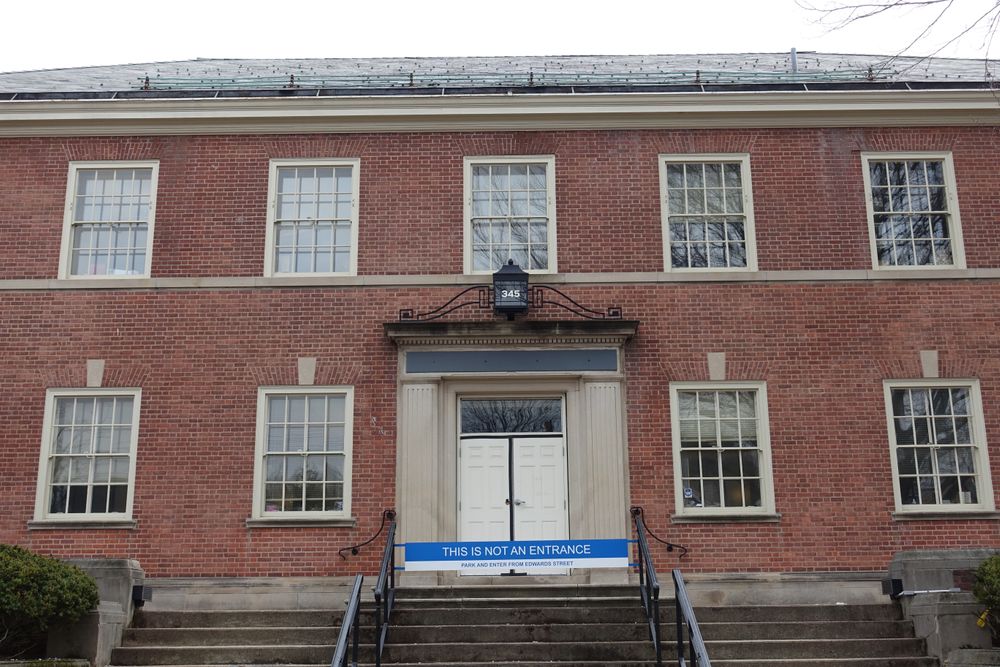
Comments
You are not logged in! Please log in to comment.